lunedì 27 maggio 2013

"Buff my tank!" - VK 30.01 (P)

By Zarax

Hello and welcome to "Buff my tank!"

The "Buff my tank!" articles are meant as an historical way to look at some tanks considered underpowered in game and ways to improve their combat abilities discussed by the original german engineers.
Beware that while being sometimes ironic in tone, the article treats about both costs and benefits of every choice and it most likely will never be listened by WG as suggestion.

Today we will tackle on a somewhat unpopular tank, the VK 30.01 (P).

Historically, the VK 30.01(P) was the test bed for many of the innovations that went into many of Dr. Porsche's designs , sharing both their strengths and weaknesses.
Although it never left the prototype stage, it's direct evolution was the Tiger (P) which saw limited production and battle in one example, with most being reconverted in the Ferdinand/Elefant.

In WOT it's seen as a middle ground tank between the VK 36.01 (H) and the other, more agile lines.
In terms of game-play it's indeed pretty average and there have been many buff requests in the past, however let's look at what german engineers imagined for this tank, using "Panzerkampfwagen VI P (Sd.Kfz.181) The history of the Porsche Typ 100 and 101 also known as the Leopard and Tiger" as historical source:

 Protection:

As only one prototype was ever built and its development was superseded by Tiger (P) no plans were ever made to up-armor the VK 30.01 (P).
However, given that its successor was not a radically different tank and itself was up-armored with bolt-on plates, it wouldn't be impossible to imagine the same treatment, possibly with an easy to produce 30 or 50mm add-on plate.

Mobility:

The prototype twin 210 HP engines were sufficient to obtain a top speed of 60 kilometers per hour on optimal terrain, although with very high fuel consumption.
Again, as Tiger (P) mounted basically an uprated version of the 30.01 engines, upgrading to twin 310 HP for a very respectable power to weight ratio of  17/18 HP/ton.

Firepower: 

First of all, WOT stock 75mm L/48 cannon is an historical mistake and introduce purely to prolong the grind on the tank and "encourage" the player to use gold for free XP:


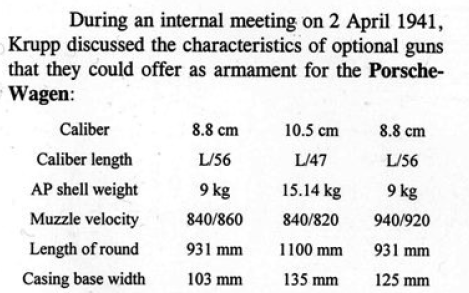
Krupp showed some extremely interesting proposals for the VK 30.01 (P).
The standard issue cannon was supposed to be the 8.8cm K.W.K. L/56 just like Henschel's Tiger, but more options were discussed:


A proposal for a 10.5 cm K.W.K. L/47 was competed on April 10, which would likely have been a redesigned 105mm L/52 for tank use with slightly lower penetration, but the most interesting one was the proposal for an higher velocity version of the 8.8cm K.W.K. L/56 on April 18 using fatter shells.

Both options would have given more than outstanding firepower, especially considering how deadly the FLAK 36 already proved to be on the battlefield but unfortunately both were discarded as one used a non-standard army caliber (not that this stopped Krupp from trying it again later on) and the other would likely have depended on the use of always scarce Tungsten due to the shell shatter effect at such high velocities.

It is also likely that both options would have meant reduced ammo capacity and in case for the 105mm also lower rate of fire, especially if the two piece ammunition was retained.
Mobility would also be adversely affected by an heavier gun, something that made the normally adventurous Dr. Porsche refuse the idea of an 88mm L/71 on Tiger (P) later on.

Conclusion:

In WOT terms the tank is fairly balanced, although personally I wouldn't mind a little more agility.
Historically the tank design was rejected because it was too complex to maintain for the battlefield conditions, used precious copper and was seen as generally unreliable, with the electric motors often developing a tendency to overheat, although the VK 30.01 (P) prototype served as an excellent test bed for such an advanced drive train for its time.

Its direct evolution, the VK 45.01 (P) was also marred by the same faults and rejected because of them and thus lost to the more standard Henschel counterpart.
Still, as many other Porsche designs it sprung many innovations and although most of them never reached production stage it is still a monument to tank engineering ingenuity.

All in all, I'd say Balanced for WOT, most upgrades are already in place and the ones missing would be more fitting for one tier higher or a tank destroyer.

Thank you for reading and see you in the next article!

lunedì 6 maggio 2013

"Misfit" Tank Destoyers - Sturmgeschütz III mit 8.8cm

By Zarax

The "misfit" tank destroyers are a series of more obscure designs that could fit an hypothetical fifth tank destroyer tree in WOT. 
These designs are much more likely to ever appear as premium tanks rather than as part of a regular tree, so they will be treated separately.

One of the most obscure STUG III variants is the design project of mounting an 88mm cannon on its chassis.
Such a powerful weapon would have made the STUG even more versatile as the larger caliber gun would have been extremely useful both against tanks and softer targets thanks to the heavier HE shell.

The concept reached wooden model stage and as seen from the picture, would have required a redesigned superstructure and likely made the tank itself heavier:


How would the tank behave in WOT?

Baby Jagdpanther II comes into mind.
Good alpha although not stellar penetration for its tier, coupled with a fairly mobile chassis.
Depending on superstructure armor (would it be 50mm or the heavier 80mm? I'd go for tier V premium with 50mm and decent mobility) it could also be fairly mobile but given it would be slightly taller than the base chassis camo would suffer a bit.

Now, would you like to see this tank as a tier V premium or as a regular tank?

domenica 28 aprile 2013

"Buff my tank!" - Panther

By Zarax

Hello and welcome to "Buff my tank!"

The "Buff my tank!" articles are meant as an historical way to look at some tanks considered underpowered in game and ways to improve their combat abilities discussed by the original german engineers.
Beware that while being sometimes ironic in tone, the article treats about both costs and benefits of every choice and it most likely will never be listened by WG as suggestion.

Today we will take a look at another popular german tank, the Panther.
A classic sniping medium, the Panther has often been object of complaints for being poor at closer ranges and having low agility.

Historically, the Panther was a proto-MBT, basically halfway between medium and heavy tanks.
Agile enough for fast tactical relocation, reasonably armored and with good firepower for its introduction, its main enemy was often the unpolished status of many components, rushed to the battlefield without being properly tested and resulting in many tanks being lost before contact with the enemy.

Of course that did not stop german engineers to keep improving on it and even bringing some wildly experimental technology on it, including but not limited to IR sights for night fighting.
Using Spielberger's "Panther & its variants" and "German Jet Engine and Gas Turbine Development 1930-1945", we will explore some solutions adopted or planned in order to push the Panther forwards to its very design limits.

Protection:

On June 4th 1942, Hitler expressed doubts about the 80mm inclined armor and requested that all vertical front surfaces should be at least 100mm thick.
In February 1943 it was also proposed to increase the front glacis plate to 100mm thickness, which would have added approximately half ton of weight.
This would basically give the tank near Panther II protection levels and definitely make the tank unbalanced as tier VII medium as it would be better armored and more mobile than the Tiger.

Mobility:

The HL 230 engine was originally planned to be made from light weight alloys (alluminium?), so some engine weight could be shaved off in theory.
An hydro-dynamic transmission like that of the E-Series was also planned, increasing tank agility on soft terrain.

In December 1943 Daimler-Benz planned to use a MB-507 engine with 850HP on the Panther chassis.

In January 1945 the 850 HP Maybach HL 234 was planned to be mounted.

Those modifications would basically be the ones implemented in game for the Panther II, yet something even crazier was considered:

From 14 Semptember 1944 until February 1945 experimental development went into trying to fit a gas turbine the Panther's engine compartment.
The turbine development went into different stages from GT 101 to GT 103 and while successful into mounting the engine, fuel consumption  was about twice as the original engine, leading to putting fuel tanks in most free space in the tank.

This engine would provide an amazing 1150 HP but as it was bigger than the standard engines and took a lot more fuel storage, it would be balanced by an high fire risk, likely at least 50%.
This would make the tank even more of a glass cannon, meaning that exposing anything else other than the turret would mean a huge fire risk.
IMHO this last solution should have gone into the recon Panther in order to compensate for the hopelessy huge size as anyway light tanks have to rely on not being hit.

As a bonus, it would have its own unique engine sound:


Firepower: 

The planned 75mm L/100 is already in WOT, however it's not the only gun improvement planned for the Panther.
In November 1944 the 88mm L/71 was planned to be installed in a Panther schmaulturm, although this was already in game when Panther was one tier higher.
Given that the long 88 was being redesigned for the task to improve shell handling, it would translate into a pretty low DPM in game.


A semi-automatic loader was also proposed and the prototype manufactured, which would have allowed a ROF of 40 RPM as long as the loader could keep the pace.
Now, this could be implemented as a new gun and balance as a 4 round drum loader or with some worsened soft stat, depending on developer mood.

In June 23 1944 a 15cm STUH 43 was proposed to be mounted in a standard Panther turret:


This would make the Panther an excellent troll tank although with likely huge reload times.
I'd personally see the SturmPanther as a TD, where it could be otherwise balanced.

Conclusion:
IMHO the tank is balanced for its specialist role of sniper medium.
A slightly different gun choice could help the tank in the brawling role, however most upgrades would basically cross the tier balance, meaning it would have to give up somewhere else.

lunedì 22 aprile 2013

Extending the WOT german tech tree - Porsche heavy tanks

By Zarax

 Disclaimer: 
This is a purely speculative article that takes into account WOT German tech tree and uses historical tanks to speculate possible new tank additions.
While trying to keep the articles faithful to history some room for inaccuracy is allowed within these rules:

1) No tank or tank part will be 100% made up, at least a mention about tank role and vague specs are needed

2) Components not planned for the tank are allowed, provided it wouldn't create grotesque inaccuracies like putting a gun that would obviously cripple a tank under its weight

3) This will be limited to WWII plans, anything post war risks to be too arbitrary to properly balance

No serious expectation of anything listed to appear in WOT as described is applied, but as we're discussing about implementing history into an arcade game some items will be controversial.
This is unavoidable as WOT tech tree rules need a tank to be better than the previous one and ergonomics are not exactly cared about, meaning that most designs are over-performing their real counterparts.


This article of mine will also be slightly different, first of all because it is aimed at revolutionize an already existing tree, but also because unlike the previous ones it will start in reverse, from tier X.


The "Porsche unleashed" articles brought a lot of attention towards the good old German colossus, a tank that many feels is becoming obsolete in a world of fast, hard hitting tanks where armor is loosing importance.

Initially I wanted to do a "Buff my tank!" about the Maus, but with the recent news influx I instead decided enough material for a massively reformed tank tree.

Note: A similar article will follow for the Henschel branch, please bear with me some odd-looking things when compared to the actual trees.


So, how do you improve a tree in which so many tanks are already overstretched from their historical counterparts?

Simple enough, you nerf them back to history:

Don't worry though, the nerfs are in reality buffs, as a massive down-tiering will also follow.

The main aim of this reform is twofold:
restore the specialization of the Porsche tree and improve historical accuracy.
This way, they will behave close to the soviet IS-4 line, in which you have slower, heavily armored tanks that also can retaliate nastily, although possibly not as well as their lighter armored cousins.

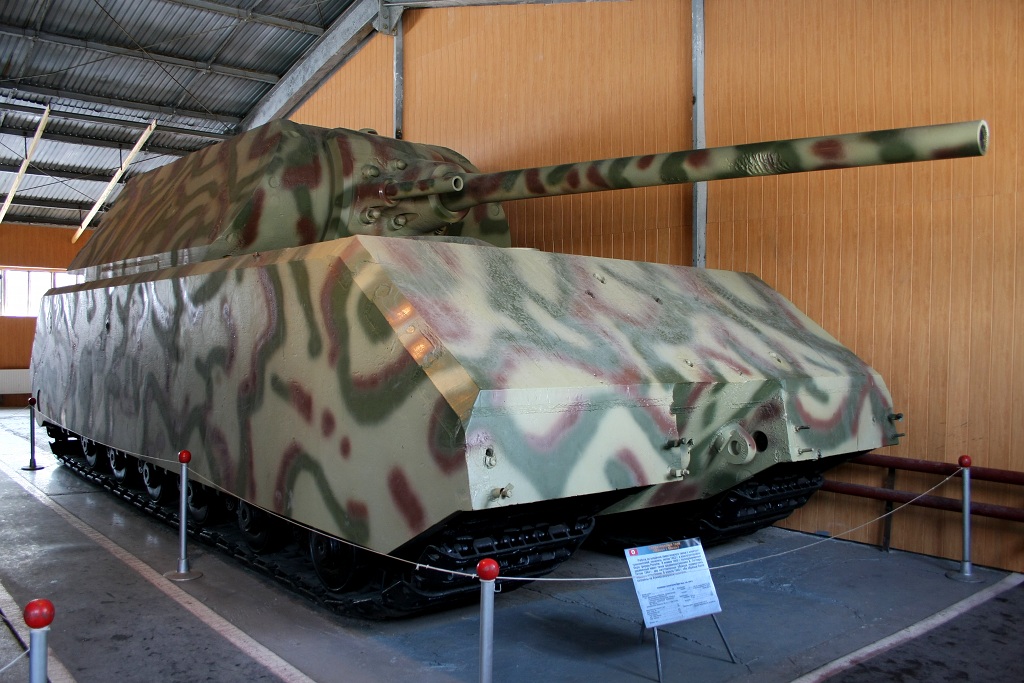
Tier X: Maus II

 
The picture says most of it.
The pinnacle of the long Maus development, this version was to receive a newly designed turret with an enlarged turret ring and several other minor improvements.

In game this would allow to keep similar mobility to the current Maus, with the possibility of installing the 128mm L/61.
This would allow the Maus to improve its ability to fight off other heavy tanks, although the price for increased penetration would likely be in DPM, soft stats and/or HP.

Tier IX: Maus


The historical Maus and current tier X.
While keeping its mighty armor, it pays an hefty price for it in terms of mobility.
The extremely optimistic 1750HP engine is kept for tier X and replaced by a weaker one.
Starting from the absolutely terrible Porsche Typ 205/2 rated at 780HP, it follows to the MB 509 at 1080 HP to the final 1200HP MB517, for a top speed of 13kmh.

Armament wise, the stock cannon could be the 105mm L/68 (basically the production version of Lowe's cannon), followed by 127mm "KWK 41" (derived from naval artillery and discussed during development) L/45 to the classical 128mm L/55 that was finally mounted on the prototype.

We even have historical stock and elite turrets:

 
This would make Maus a real grind, where you will have to rely on armor but at the same time a force to be seriously reckoned with when top tier as most tanks won't easily penetrate you without gold ammo.

Tier VIII: VK 100.01 (P)

An early Maus draft,design specs were fluctuating wildly at this stage so we can take a few liberties to use different pieces of the early Maus development  to fit it on tier VIII.

Derived from the Porsche/Krupp VK 70.01 Lowe project, this 100 ton tank was to be heavily armed but with less than spectacular armor.
Basically a Lowe on steroids, frontal armor was planned to be 120-140mm with sides at 80-100mm.

The Porsche Typ 205/2 rated at 780HP will serve as stock engine, replaced later on by the Porsche Deutz Typ 180/2.
Mobility would still be relatively low, around 20-25kmh but this would be compensated by the armament side.

As neither armor or mobility for its size are especially spectacular, we can slightly compensate with armament.
88mm L/71 will serve as stock gun, with a first upgrade being the 88mm L/100.
105mm L/52 and 105mm L/68 will serve as upgrade path towards the Maus, however we can allow ourselves one optional gun.

Depending on chosen armor thickness, either the 127mm L/45 or the 15cm SFH L/30 could be used.
One is a naval gun firing semi-AP shells, while the other would be a tank version of Hummel's upgraded gun, so an howitzer with a semi-decent gold round.

Tier VII: VK 45.02 (P) Ausf B

The good old tier IX tank was in fact so overbuffed by Wargaming that it's almost unbelievable.
Historically, both ausf A and B were designed for the 88mm L/71 and sported a meager 80mm frontal armor.
While being sloped means that it would be marginally better than Tiger's, by WOT standards it's just paper.
It was planned to increase it but no amount is given, although we can be sure it wouldn't be as much as right now.

A more realistic amount could be anything from the original 80mm up to 130mm depending on effects on mobility and additional plating availability.
For balance purposes, I will allow myself to use an additional 30mm plate (the most common size for this purpose), bringing protection to a decent 110mm.

Keeping top speed the same, the engine grind will be the same as the current Tiger P, with the Porsche Deutz Typ 180/2 as top engine.
Armament wise, the 88mm L/71 is kept as top gun, while the 88mm L/56 will serve as stock gun.
A middle gun option can however be introduced in the form of the 105mm L/47 (source: Jentz, historically planned for the Porsche Typ 100/101), which for simplicity sake could share ammunition (and penetration stats) with Dicker Max gun, of course with lowered firepower and accuracy.
Tier VI: Tiger (P)

As this tank is quite popular I'm going to leave two paths: armor OR firepower.
In both cases the last engine has to go, along with the 88mm L/71, but don't despair yet.

Option 1: Armor
Simple enough, as tier VI heavy with such awesome armor, the long 88 has to go.
200mm at tier VI is simply excellent and a gun selection like the current VK 3001 (P) will be more than enough, transforming your tank into a strong anvil that can still pack decent firepower although lowish penetration.

Option 2: Firepower
A more balanced setup, this will leave you with a decent 100mm frontal armor, which will help making the tank lighter and keep some mobility.
The new top gun would be the 105mm L/47, which would basically make the tank comparable to ARL 44 or T-150 in game play.

Tier V: Porsche Typ 245


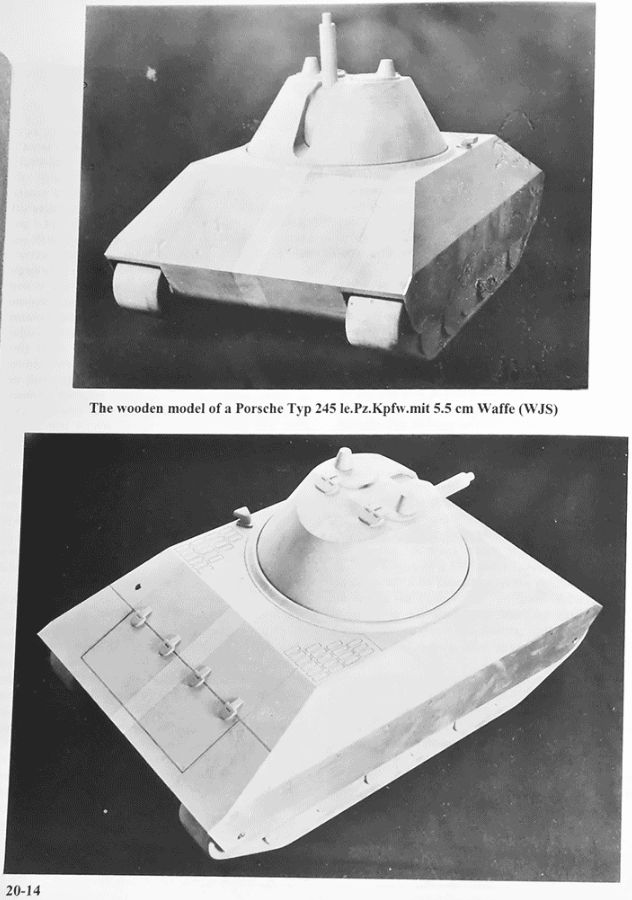
Outshone (or maybe shadowed is a better way to describe it) by the heavier Porsche designs, this Porsche-Rheinmetall light tank is another pretty "original" design in line with most Porsche proposals.

Apparently supposed to double as AA tank and armed with a 55mm auto-cannon, it was planned to be equipped with a Porsche Typ 101 engine with an advanced hydraulic transmission.

This 18 ton light tank was also well armored with a sloped 60mm glacis armor and interesting enough, it already was planned to use rubber-saving steel wheels, all in slightly under 5 meters length.

In game it could play a similar role as the british cruiser tanks, basically a light-medium tank with normal MM, armed in a similar way to the tier VK 1602.

 Of course, this leaves out two tanks from the existing tree.
I personally envision them as a connecting branch to the Henschel line, specs for them follows below:


Tier VII: VK 45.02 (P) Ausf A

The good old tier VIII tank was in fact so overbuffed by Wargaming that it's almost unbelievable.
Historically, both ausf A and B were designed for the 88mm L/71 and sported a meager 80mm frontal armor.
While being sloped means that it would be marginally better than Tiger's, by WOT standards it's just paper.
It was planned to increase it but no amount is given, although we can be sure it wouldn't be as much as right now.
The historical 80mm armor will be kept for this tank, maintaining its "fast heavy" role.

Keeping top speed the same, the engine grind will be the same as the current Tiger P, with the Porsche Deutz Typ 180/2 as top engine.
Armament wise, either the 105mm L/47 or the 88mm L/71 can be used as top gun, while the 88mm L/56 will serve as stock gun, although I'd favor the first.

As top of the "linking branch" this tank would be able to upgrade towards both VK 45.02 (P) Ausf B and either tier VII or VIII of the Henschel branch.

Tier VI: VK 3001 (P)

I really wanted to bring this tank down to tier V, however historical specs are in such a way that the tank is already where it belongs. Blame on WG for the horrid grind, it's completely unjustified from an historical POV.

Top specs for the tank are already quite good, so there is no need of changing them.
What is possible however, would be to ease the pointless grind that forces the player to research both tracks and turret to mount anything better than a 75mm L/48.
WG just conveniently buys on the myth that the original turret wouldn't fit a bigger gun, however the Krupp design shows an 88mm L/56 on it.

Tank upgrades would be the Tiger (P) naturally and VK4502 (P) Ausf A.

I also wanted to bring the VK 72.01 as tier VIII but unfortunately WG took it as made-up tier X.
It would also have been extremely hard to balance as tier VIII, as thin armor coupled with E-100 top gun are an extremely odd mix for a heavy tank, even balanced by awful DPM.

With this, our article ends and I sincerely hope you enjoyed reading about the mix of odd and utterly crazy Porsche designs.

venerdì 19 aprile 2013

E 50/75 Weserhütte

By Zarax

Note: much credit goes to Thor_Hammerschlag for noticing the hull size differences.
As usual, don't expect anything published here to be implemented in WOT.

Today I got an interesting message from Thor, saying that there was something unusual on page 75 of "Special Panzer Variants" by Spielberger (btw, did you know that he actually worked as engineer for Porsche and was involved in the Ferdinand project?).

The page shows the E 50/75 hulls, however aside from the two well known Adler layouts there is another, slightly different one by Weserhütte:

 
Not much is known about it other than the company was responsible for E 50 and E 75 but the interesting bit is that the chassis is about 15cm longer.
It is not known either if this was an early draft or a later development, however this extra space was likely to be enough to accomodate the planned rear drive transmission. 

All in all, this is yet another shadowed corner in the already pretty obscure development of the E-Series.
I will further investigate but it's unlikely anything else will be found, especially as even Jentz and Doyle seems to have given up on this (or maybe Doyle is keeping any new data for the next issue).

Addendum:
I've received several comments in the FTR blog about the WOT frontal transmission debate.
I originally did not want to get involved on it but given that it's been brought forward, I will try using several sources to make estimates.

First of all, Wargaming argues that the rear transmission wouldn't fit  as the Tiger II was too short, and brings the longer (I'll take as granted their 7.35m hull measurement) AMX 50B as example of follow-up design.
So, basically their argument can be summed up by two pictures:


I will also bring a larger, detailed AMX picture:


Problem is, how long effectively the tanks were supposed to be?

Wargaming states first that Tiger II was 6.4m long, then corrects itself to 7.3.
The first number would indeed prove WG right, however the latter would basically give identical measures to the french design, thus allowing rear drive beyond doubt.
 
Using Jentz & Doyle's Tiger II book, we obtain the following:


At 7.38m we have basically the same size as  the french AMX, meaning that a rear drive on Tiger II would be possible indeed.

Later measurements however are slightly different:


This gives a range from 6.8m (Krupp late improvement estimate) to 7.1m (Heschel 1944 measurements), still significantly longer than Wargaming's initial estimate.

Now, how long was E 50/75 supposed to be?
The answer here is much more complicate, as data is extremely scant.
The only measurements safely obtainable are the ones on the top, which only gives suspension length.

Thus, to compare we need the same measurement from the Tiger II.
Henschel measurements gives 4120-5400mm depending on terrain (up to 20cm of track sinking).

Comparing to the Adler data, it seems that their E-50 would be just slightly shorter than Tiger II (possibly going towards later Krupp Tiger II proposals?), while Weserhütte design seems to be in line with the Henschel Tiger II or slightly longer.

So, what does this tell us?

1) Tiger II hull is a lot closer to AMX M4/AM 50 in size than initially estimated by Wargaming
2) There likely were attempts of shortening (thus making it lighter) Tiger II hull by germans
3) Kniepkamp and Wa Prüf 6 possibly estimated larger sizes than production models

In my opinion, giving rivalries in tank development WG implementation is partially correct, although they explained it in the worst possible way.

Here's what I think could have happened:

Early prototypes would likely have been produced by Adler with forward transmission in an attempt to keep tank weight as low as possible and reusing as many Tiger II/Panther components as possible.
We also have to consider that Adler itself was working on a rear drive though, the "Projekt B" Hydro-mechanic drive and transmission, so later models might have succeeded in following engineer's will.

Weserhütte and other minor manufacturers in the meantime would likely have tried to keep closer to engineer's specs as they had less political clout and were keen to get a slice of the tank production business.
This would have resulted in a longer design, possibly with initially worse mobility (and reliability) and heavier weight for sure.

All in all, both might have converged in a final design possibly closer to the french implementation but as the very nature of the project itself was highly speculative we'll never know for sure as it's likely single components would have been implemented in existing tank designs instead.

mercoledì 17 aprile 2013

Sorting out the 210mm Ferdinand

 By Zarax


The introduction of "GW-Ferdinand" by Wargaming left me scratching my head.
The first reaction was "yet another fantasy tank!", but I had an hitching feeling about reading a "21cm auf Elefant" somewhere.

The first hint came from the forums, where "Panzer Leader" by Guderian was mentioned as a source.
It is there indeed mentioned as a proposal (among other things, like additional front plating for Tiger, Panther and Panzer IV)  but I still was not sure as he seemed to be mixing out stuff. The fact that the 210mm mortar itself was nicknamed "Elefant" due to its weight didn't help of course as it could have allowed further confusion.

"Gunpower 22", by Tadeusz Melleman briefly mentions that heavy self propelled guns on Tiger P chassis were proposed for 150 and 170mm heavy howitzers on page 7, however no source is given, leaving me skeptical about it, although it mentions the same reason for dismissal as Guderian's, economic cost. 

This led me to dig deeper into the main authors. A deeper check into "Special Panzer Variants" by Spielberger revealed a "Elefant 21cm on Hummel chassis" proposed on March 1945 but it turned out to be talking about the mortar itself rather than the tank.

"Panzer Tracts 08" gave a precious start, saying in thr Sturmpanzer IV chapter that succesfull production of the model would stop the need for a 21cm Tiger (P) based Stug. This, and the fact that Sturmtiger itself was initially considered to use a similar howitzer, made me consider the possibility of a "Sturmtiger (P)", although still not direct enough to be certain.

"Tiger und seine abarten" by Spielberger finally hit the nail. On pages 104 and 105 (translation courtesy of Silentstalker) it says Hitler wanted the conversion of Porsche Tigers into Sturmgeschütz vehicles with 200mm frontal armor and a 88mm L/71 gun. He also ordered the research of the possibility of installing a 210mm French captured mortars into them. For that, the hull and the superstructure was to be strenghtened. 

The order to rebuild one (Porsche vehicle) into a Sturmgeschütz was given by the army high command to Porsche on 26.9.1942.  On 14.10.1942 Hitler said that if Panzer IV could have the SIG gun installed, the need for the 88 or 210mm Porsche Tiger Stug has no longer priority and only constructive suggestions should be given from now on. 

What does this mean?

Basically, a 210mm assault mortar used as howitzer on a Ferdinand. Same armor, likely slightly different superstructure but definitely a front line tank, not an artillery unitSo, after VK 7201, Wargaming did it again and utterly misread a german design.

Will they ever learn?

Bonus detail: On 5.1.1943 Hitler requested the trials of a 88 L/100 on Tiger P chassis.

Addendum for those that argue about its use in WOT

My articles are purely on an historical perspective although usually based on WOT tanks or events.
My aim is to rectify historical accuracy mistakes, not to create WOT tank designs.

Someone pointed that the armor on a "mortar carrier" would be useless thus it's not logical.

This tank was not meant for facing other tanks tanks but rather bunker defences (which included anti-tank guns) in an urban settings, while the tank role was simply to bring the biggest gun close enough to do the job.

I'll try to explain the role in simple words:

1) Pick a big city (historically, Stalingrad).
2) Infantry discovers a fortified building that indirect fire artillery cannot reach
3) Tank caliber guns fails to breach the reinforced walls
 

At this point a solution is needed:

Hitler proposed a ramming Tiger vehicle that would act like a motorized battering ram.
Someone a bit less insane proposed a vehicle armored enough to withstand anything thrown at it by bunker defences and with a large enough gun to crack it.

Implementation phase 1: a SIG heavy howitzer is mounted on a Panzer III chassis with 80mm front

Implementation phase 1.5: Hitler wants something bigger and orders the heaviest gun on his favourite engineer's (Porsche) platform

Implementation phase 2: someone saner persuades Hitler that a panzer IV with a 15cm STUH 43 short howitzer and 100mm frontal armor is enough

Implementation phase 2.5: Hitler gets angry and states that nothing less than a Tiger will scare away enemy soldiers from position

Implementation phase 3: Sturmpanzer Bar and Sturmtiger competes for the heavy sturmpanzer role, with Sturmtiger winning the competition.


How would it work in battle in its concept?

The tank would simply approach the enemy strongpoints relying on strong frontal armor to resist anti-tank guns, grenades and anything a fortified position cold fire at it.
Once within range (from a few hundred meters to 1-2 kilometers) the tank would fire with a heavy howitzer and demolish the enemy bunkers either with HE or with a large HEAT demolition shell.

Tanks were not their primary targets and they were not meant to be used as tank destroyers primarily, although that role was occasionally envisioned.


Would they wreck any tank if they fired on it? Yes if close enough to score a direct hit with their low velocity guns.
Would they be optimal for the task? No, as everything in the tank is optimized for short range use against static targets. Perhaps they would be devastating in an ambush, but with the naturally slow rate of fire it would be a waste of heavy shells.


Someone likened heavy sturmpanzers to  the soviet SU-ISU 152. It is an analogy with limited purpose, as the german tanks were much more specialized in their role than the soviet design and would be out-ranged by them.


Extending the WOT german tech tree - Porsche Tank Destroyers

 By Zarax

Disclaimer: 
This is a purely speculative article that takes into account WOT german tech tree and uses historical tanks to speculate possible new tank additions.
While trying to keep the articles faithful to history some room for inaccuracy is allowed within these rules:

1) No tank or tank part will be 100% made up, at least a mention about tank role and vague specs are needed

2) Components not planned for the tank are allowed, provided it wouldn't create grotesque inaccuracies like putting a gun that would obviously cripple a tank under its weight

3) This will be limited to WWII plans, anything post war risks to be too arbitrary to properly balance

No serious expectation of anything listed to appear in WOT as described is applied, but as we're discussing about implementing history into an arcade game some items will be controversial.
This is unavoidable as WOT tech tree rules need a tank to be better than the previous one and ergonomics are not exactly cared about, meaning that most designs are over-performing their real counterparts.


Although Porsche is best known for the Ferdinand and the Maus, he worked on a plethora of lesser known designs, although most of them never left the paper stage.
Starting from 1943 and as the war material situation worsened he focused on lighter designs, some of which were tank destroyers.

By using the best sources at our disposal we're now able to attempt to reconstruct a Porsche TD line.
Beware, some designs are quite exotic but all of them are based on "Panzer Tracts 6-3", "Panzer Tracts 20-1", "Panzer Tracts 20-2"  or "Special Panzer Variants".

Due to a lack of early designs, this tree will start from tier V, in my mind branching from either the Hetzer or the Panzer 38 Neuer Art:

Tier V: Porsche Typ 245/2


Based on the Porsche Typ 245 light tank design, this light assault gun was meant to double up as recon tank and use belt-fed weapons, eliminating the need for a loader.
Designed to be fairly well armored (60mm sloped frontal armor), it was planned to be fast with a 250HP air-cooled  Porsche engine, which pushed its 15 tons at a top speed of 58 kilometers per hour, granting a pretty good 16HP/ton.

At around 1.5 meters of height and being shorter than the Hetzer, it was pretty short and hard to detect, making it a potentially great ambush tank.
Its planned armament was a 55mm Rheinmetall M112 autocannon with a traverse of 5° on each side, coupled with a light MG in the cupola.

We could estimate as upgrades that the tank could receive a Porsche Typ 100 engine variant, and keep relatively light armament.
I initially thought about 55mm Gerat 58 but it would look ridicolous on the tank, as well as its early relative 5cm Flak 41.
Considering larger guns, the 75mm L/48 would look quite big on the tank already, so it's likely we'll have to be limited to howitzers and short guns.

An autoloading variant of the 5cm L/60 cannon could be used with a 5 round drum, although lackluster penetration would not improve the situation by much.
105mm L/28 would match the tank pretty well, but it will likely mean giving up most traverse.


Stretching up a bit more, one could consider the 8cm PAW 600, which would give slightly better HE damage than a 75mm gun, however gold ammo is limited to 140ishmm HEAT penetration.
Alternatively, the 30mm MK103 or an autoloading 37mm with the uranium rounds could be considered, but this is borderline with history.

All in all, an excellent "flanking TD" useful for hunting scout tanks and protecting artillery but not exactly a pleasant grind.

Tier VI: Porsche Schwerer Kleiner Panzer


Possibly one of the first drafts of the Porsche Typ 250, the Porsche Kleiner Panzerkampfwagen was an interesting project, based on the use of cast armor to speed up building.
Another relatively compact design, it was supposed to be 2.2m tall in it's largest version, 6.75 meters long and 3.15 meters wide.

Fairly well protected by an 80mm sloped front, it sported a 345HP Porsche V-10 engine pushing 25-26 tons, making it a still relatively agile vehicle at 13HP/ton, while crew was now composed by 4 members.
Its initial armament was supposed to be the 105mm L/28, with a 30mm autocannon as secondary weapon.
Top speed is not given but one could estimate around 45-50kmh on ideal terrain.

During its development upgrading the cannon was considered.
Sources are slightly sketchy on this though, as they state a 10.5cm PAW firing fin-stabilized ammo at 900m/s was planned.

Now, this leaves us in a bit of a conundrum:

While there was a 10.5 PAW firing fin-stabilized ammo (called 10H64, it reached prototype stage), it was rather a low velocity gun-howitzer meant to fire HE and HEAT than a long gun.
On the other side, the only gun in the german arsenal that could match the performance specs (105mm and 900m/s) would be the 105mm L/68 proposed for the Tiger II, which in its rifled version was estimated to reach around 860 m/s, but on the tank with a front mount it would make the tank almost twice as long, not to mention making it nose heavy and unmaneuverable in city or wooded terrain.

This leads me to two hypothesis:

1) The 10H64 was meant for a front mount, while the long 105 for a rear casemate. It could fit with some difficulty but there are no designs to support this.

2) Speculating on a wrong translation and given the british authors, it is more likely 900 feet per second were meant, a performance quite close to the 10H64 cannon.

Personally, I think the latter option is more likely, but given that in WOT smoothbore guns are not a welcome option (although in this case it would be a "derp gun") we could speculate the tank would mount yet another design as top gun, the 105mm L/47.
Rougly as long as the 88mm L/56, it was designed by Porsche to fit the VK 3001 (P)/Tiger (P) turret and we could estimate a similar performance as the russian 107mm or french 105mm of tiers V-VI.

As for mobility, it is likely the V-10 engine would be later replaced by a 500HP V-12 that was in development, granting it nearly 20HP/ton, pushing the top speed to over 50kmh.

Tier VII: Porsche Typ 255


Sometimes confused with the E-25, this 1944 design was the ultimate "light" tank destroyer by Porsche.
Roughly the same size as its tier VI predecessor, it was designed to sport 120mm frontal armor, 4 man crew and a semi-automatic (mentioned as "belt-fed", likely an auto-loader) cannon plus a 30mm MK 103/108 in the small turret above.

A 500HP V-12 engine was supposed to push its 27 tons of weight to a top speed of 57 kilometers per hour, which at around 18HP/ton would have made the vehicle quite agile, although it's likely the weight was under estimated.

Weapon-wise, Spielberger states that the 105mm L/28 was originally planned, but later to be replaced with a semi-automatic 10.5cm cannon of higher performance.
In this case, one could assume we'd end up with a similar armament as the WOT Jagdpanther, although given the better chassis specs gun would inferior in performance, with in my opinion a final choice between a drum loaded version of the howitzer and the 88mm L/71 or 105mm L/47 if the 10H64 is not picked.

Engine-wise, we could maybe expect the same choice as Ferdinand or a bit lower in HP as the initial mobility is already quite good, with the possibility of the historical engine being the top one.


Tier VIII: Ferdinand

As the tank is already in WOT and no tier changes are expected, only minor adjustments are foreseen.
WOT already upgrades this tank above historical plans so not much could be said.
If one wanted to improve slightly historical accuracy an 88mm L/100 or 105mm L/68 could be used instead of the 128mm L/55 as they would be more plausible as upgrade but still fictional.

Tier IX: VK 70.01 (P)

The biggest historical stretch of this tree, but necessary to find a proper design for the tier, this was supposed to be Porsche proposal for the Lowe tank, dated 11 may 1942.

Coinciding with the "Schwerer Lowe" specifications, it was a 90 ton tank design, with 120mm front armor, 80-100mm side and armed with a 15cm L/40 (likely E-100s L/38) cannon.
2 Porsche engines of unknown power were supposed to push the tank at 30 kilometers per hour.

Now, for the speculative part:

A chassis length of over 7.7m is given, making it likely rear turreted, something that is to be expected by a Porsche design.
A width of around 3.8m is given, touching slightly above 4m with what is expected to be side skirts, or possibly with tracks mounted.

This would give it a pretty familiar look, one that WG took for tier X:


Playing with similar designs, one could imagine the final product as something close to this brutal merge:

The image above is of course NOT historical and it's merely speculation on how the Schwerer Lowe turret would look with a chassis similar in size to the Porsche design, in this case the Sturmpanzer Bar.
120-140mm frontal armor and E-100 level gun selection, it wouldn't be exactly top spec in either armor or firepower, so we could argue that this tank would be a turreted TD.
Starting with the 105mm L/68, one could likely grind the 128mm L/55 up to the 15cm L/38 or L/40.
Limiting slightly the turning ability an heavier gun could be likely carried, such as the 128mm L/61.


Tier X: Sturmgeschutz Maus


The above is an artist impression, however it's pretty likely the Sturmpanzer Maus would have looked like that.
Developed in tandem with the JagdPanzer E-100, it was supposed to be pretty similar in gun selection, with a choice between the 15cm L/63 (or L/68) or the same 17cm carried by the Jagdpanzer E-100.

A relatively simple trade-off, it would get slightly better armor in exchange for slightly worse mobility.
Aside from the above mentioned guns, extra long 128mm cannons up to L/76 were mentioned, however it is unlikely they could bring much tactical benefit, although one could prefer an extremely precise low alpha cannon.

With this, the line ends.
Although some pretty heavy streching from history has been taken in some cases, all tanks above existed at least in plan form as a list of specification.

No fantasy tanks or Wargaming developers have been harmed in the making of this article.