Just back from that wonderful city, I had the chance to visit the Belgian Army Museum of Military History.
Although some expositions were under renovation (unfortunately both the WWI section and most of their tanks), it was still a pretty interesting tour and I couldn't resist taking some pictures and sharing with you guys.
Unfortunately a strict no flash policy and phone camera means picture quality isn't as good as I'd like, but nonetheless...
Enjoy:
domenica 25 agosto 2013
lunedì 12 agosto 2013
The long evolution of Henschel heavy tanks
The famous Tiger tank wasn't created in a day.
Durchbruchswagen
Its roots can be traced back to January 1937, when Wa Pruef 6 asked Henschel to develop designs for a 30 ton tank armed with a 7,5cm cannon.
The Panzer project was initially called B.W. (Begleit Wagen verstaerkt, reinforced escort tank), implying a similar role as the similarly named Panzer IV design.
The name and intended tactical role didn't last long and on 28 April 1937 it was changed to D.W., Durchbruchswagen, or breaktrough tank.
The design specified a 30 ton tank with 50mm armor all around, pushed by a 300HP MB HL-120TRM to a maximum speed of 35km/h and the 75mm L/24 cannon.
Turret ring was 1500mm, close to Panzer III specs meaning it could accept pretty much the same turrets and guns.
Developed in parallel to the VK 30.01, VK 65.01 was to be a heavy breakthrough tank.
The focus was put on protection, with armor upgraded to 80mm all around to give protection from 5cm cannons, while top speed was lowered to 20-25kmh.
The turret was to share components and general design with D.W/VK 3001, only with thicker armor.
In January 1939 Krupp proposed 3 different guns for the tank: the basic 75mm L/24, a 75mm L/40 and a 105mm L/20.
75mm cannons were preferred due to better performance against bunkers and easier to store ammunition.
The tank was to be truly massive, with a hull that had to be dismounted in 3 pieces in order to fit railway profile.
A Maybach HL224 engine rated 600HP was chosen as power plant, pushing the 65 tons tank at 20kmh.
The project was scrapped after the defeat of France because of bridge restrictions and because Wa Pruef 6 felt that tanks above 30 tons were operationally of limited use.
VK 36.01 (H)
Durchbruchswagen
Its roots can be traced back to January 1937, when Wa Pruef 6 asked Henschel to develop designs for a 30 ton tank armed with a 7,5cm cannon.
The Panzer project was initially called B.W. (Begleit Wagen verstaerkt, reinforced escort tank), implying a similar role as the similarly named Panzer IV design.
The name and intended tactical role didn't last long and on 28 April 1937 it was changed to D.W., Durchbruchswagen, or breaktrough tank.
The design specified a 30 ton tank with 50mm armor all around, pushed by a 300HP MB HL-120TRM to a maximum speed of 35km/h and the 75mm L/24 cannon.
Turret ring was 1500mm, close to Panzer III specs meaning it could accept pretty much the same turrets and guns.
VK 30.01 (H)
Following D.W. development, between 1938 and 1939 it was decided to keep the same general specs, but for a panzer with roughly the same internal space as Panzer IV.
The initial engine was the 300HP MB HL 116, proposed to be upgraded either to a 375HP Maybach HL190 or a 400HP MB HL 150 which would have brought HP/ton from 10 to either 12,5 or slightly over 13.
Krupp redesigned the turret to be compatible with minor changes with both VK 30.01 and its heavier cousin the VK 65.01 just by increasing armor thickness, while the armament for now was still the 75mm L/24 howitzer.
By 1941 however this was quickly becoming obsolete, so up-gunning attempts were considered.
At first a 7,5cm L/34,5 was considered, but Krupp replied it couldn't be mounted without extensive turret modifications.
The 5cm L/50 or L/60 could be considered instead, as modifications required were quite less demanding.
The conical 7.5cm Waffe 0725 was proposed but discarded as it couldn't be installed as well.
By December 1941 Krupp figured out a way to fit the 75mm L/43 although with some ergonomic difficulties for the commander, while on January 1942 they replied the 7,5cm KWK 44 could be fitted only with numerous design difficulties and what basically amounted to a turret redesign.
All in all, the project was stopped because it failed to offer a valid improvement over the now battle tested Panzer IV and the design itself was becoming outdated and difficult to upgrade.
VK 65.01 (H)
Developed in parallel to the VK 30.01, VK 65.01 was to be a heavy breakthrough tank.
The focus was put on protection, with armor upgraded to 80mm all around to give protection from 5cm cannons, while top speed was lowered to 20-25kmh.
The turret was to share components and general design with D.W/VK 3001, only with thicker armor.
In January 1939 Krupp proposed 3 different guns for the tank: the basic 75mm L/24, a 75mm L/40 and a 105mm L/20.
75mm cannons were preferred due to better performance against bunkers and easier to store ammunition.
The tank was to be truly massive, with a hull that had to be dismounted in 3 pieces in order to fit railway profile.
A Maybach HL224 engine rated 600HP was chosen as power plant, pushing the 65 tons tank at 20kmh.
The project was scrapped after the defeat of France because of bridge restrictions and because Wa Pruef 6 felt that tanks above 30 tons were operationally of limited use.
VK 36.01 (H)
In june 1940 specifics for a 30 ton class tank were laid, including a 10,5cm cannon as main armament.
Later on, the need of a high penetration weapon resulted in the proposal of mounting the Konical 7,5cm Waffe 0725.
The turret deserves a bit of attention on itself:
In 1939 a turret with 100mm armor mounting a 10,5cm cannon was developed, for a speculative design called A.W., Artilleriewagen.
Unfortunately no design specs survive other than the fact it would have been in the 80 tons class.
As tanks over 30 tons were deemed unsuitable for army needs, the panzer design was scrapped, while Krupp was asked to adapt the turret design (now finalized to use the 10,5cm LEFH 18) to the D.W. chassis.
This was achieved by reducing armor to 80mm front and 50mm sides, with an 80mm thick mantlet.
The D.W./VK3001 was then redesigned to take this improved turret, with increased weight to 36 tons.
The initial design called for 80mm frontal armor, 50mm side armor and was powered by a 450HP Maybach HL 174 engine.
Requests for up-armoring came up soon enough and the design was brought to 100mm frontal armor and 60mm sides, bringing the tank up to 40 tons.
Tungsten shortages brought the project to a halt, especially as the turret ring couldn't support the 88mm L/56 gun, making development switch priority to the larger and heavier VK 45.01 design, the well known Tiger.
This wasn't the death of the plans though, as in 1942 the 7,5cm L/70 was proposed for the design along with the Tiger and VK 30.02, although after this details are lost in Tiger's development.
The only produced VK 36.01 chassis ended up as towing tractor, while the 6 turrets produced for it became part or the atlantic wall.
VK 45.01 (H), aka the Tiger
In May 1941 Henschel was awarded a contract to redesign the VK 36.01 chassis so that it would house a turret suitable to mount the 8,8cm KWK, already developed for the Porsche chassis.
The redrawn specs brought the project to 45 tons, with many components taken from the VK 36.01, while side armor was raised to 80mm.
A new engine was specified, the 600HP Maybach HL 210, while a Rheinmetall turret suitable to house a 75mm L/60 gun, then 75mm L/70 was also considered.
A conversion to use the 88mm L/71 was also planned for late 1942, but never carried out.
Later on, the need of a high penetration weapon resulted in the proposal of mounting the Konical 7,5cm Waffe 0725.
The turret deserves a bit of attention on itself:
In 1939 a turret with 100mm armor mounting a 10,5cm cannon was developed, for a speculative design called A.W., Artilleriewagen.
Unfortunately no design specs survive other than the fact it would have been in the 80 tons class.
As tanks over 30 tons were deemed unsuitable for army needs, the panzer design was scrapped, while Krupp was asked to adapt the turret design (now finalized to use the 10,5cm LEFH 18) to the D.W. chassis.
This was achieved by reducing armor to 80mm front and 50mm sides, with an 80mm thick mantlet.
The D.W./VK3001 was then redesigned to take this improved turret, with increased weight to 36 tons.
The initial design called for 80mm frontal armor, 50mm side armor and was powered by a 450HP Maybach HL 174 engine.
Requests for up-armoring came up soon enough and the design was brought to 100mm frontal armor and 60mm sides, bringing the tank up to 40 tons.
Tungsten shortages brought the project to a halt, especially as the turret ring couldn't support the 88mm L/56 gun, making development switch priority to the larger and heavier VK 45.01 design, the well known Tiger.
This wasn't the death of the plans though, as in 1942 the 7,5cm L/70 was proposed for the design along with the Tiger and VK 30.02, although after this details are lost in Tiger's development.
The only produced VK 36.01 chassis ended up as towing tractor, while the 6 turrets produced for it became part or the atlantic wall.
VK 45.01 (H), aka the Tiger
The redrawn specs brought the project to 45 tons, with many components taken from the VK 36.01, while side armor was raised to 80mm.
A new engine was specified, the 600HP Maybach HL 210, while a Rheinmetall turret suitable to house a 75mm L/60 gun, then 75mm L/70 was also considered.
A conversion to use the 88mm L/71 was also planned for late 1942, but never carried out.
From Tiger to Tiger II, VK 45.02/45.03 (H)
In April 1942 the first conceptual drawings were made by Henschel for an upgraded VK 45.02 (H) Tiger mounting an 88mm L/71 cannon.
At first as many automotive components as possible were taken from the VK 45.01 (H) and together with Krupp a turret for the 88mm L/71 was designed.
In February 1943 Henschel was ordered to redesign the tank in order to maximize compatibility with Panther components.
This project was called VK 45.03 (H) Tiger II.
At the same time, Speer requested compatibility with the newer Panther II project, resulting in the VK 45.03 (H) Tiger III proposal, sharing transmission, drivetrain and the Maybach HL 230 engine rated 700HP, where Panther II would use 7 roadwheels, while Tiger III used 9.
In all these early drafts the hull chassis was set to 100mm armor sloped at 50°, with Guderian mentioning a proposal to bring it to 120mm.
Hitler himself gave the final specs armor specs, declaring the frontal armor should be 150mm, while side will be set to 80mm.
In the end, the winner new Tiger would be the Tiger III (renamed as Tiger II), with the initial turret taken from the Porsche VK 45.02 (P) project.
Tiger II
The first 50 Tiger II hulls were coupled with the turret left from the VK 45.02 (P) development.
The rounded shape, while good for deflection, left a shot trap.
In October 1942 it was considered possible to start serial production in September 1943, however troubles in incorporating Panther II parts meant the first Tiger II was delivered only in November 1943.
From October 1943 to May 1944 only 38 Tiger II were produced, while production was slowed down again in October 1944 by extensive bombing raids, resulting a total of 283 Tiger II produced by end of the war.
A few modifications did not reach the end of the war:
- The Maybach HL 234 Engine rated at 800HP
- An alternative Argus-Man Engine, also rated at 800 HP
- A stabilized version of the 88mm L/71 and turret rangefinder
- A turret mounted MG 42
- An upgunned version, using the 10,5cm KWK L/68
Beyond this, the E-series...
Which will be subject of a further article.
As you can see, from the Humble D.W. to the mighty Tiger II, Henschel produced a fine tank evolution.
I sincerely hope you enjoyed reading this and will meet you in our next article!
sabato 3 agosto 2013
E-Series according to Fritz Hahn
After having talked about the Sturmpanzer E-75, we will now take a further look to the E-Series using data from "Waffend und Geheimwaffen des deutschen Heeres 1933-1945" by Fritz Hahn.
The translation has been done mostly by Google Translator with later adjustment by hand so please bear with me any mistakes.
While the author did not participate in tank development, he worked on the V2 project and claims to have had access to the original papers of tank designs during WW2.
Some stuff has likely to be taken with a grain of salt and I will try to compare passages with Spielberger where possible.
So, without further ado:
E-5
The series started with the E-5, a fast and small two man tankette of 6 to 10 tons.
Several projects have been drawn under the name "wanze" (bug).
One particularly low model was built in the same pattern as the romanian tank destroyer "Marshal" with a 7.5 cm PAK 40 cannon.
BMW proposed a design of a 3550mm long vehicle powered by a 90HP 3.5 liter engine.
A workaround was the panzerjager Bren.
On a 4t English captured tankette 3 panzerschreck were mounted, making it effectively an ambush APC.
According to Hahn, the companies Bussing, Daimler, Steyr, and Weserhütte submitted drafts together for a one-or two-seater tank destroyer armed with the 8cm PAW, although no final design was approved.
The general inspector of the armored troops refused all these drafts on 19 march 1945 and also a so-called off-mg car.
In the latter, 870kg heavy, 2650mm long and 1600mm wide vehicle, the crew was housed lying.
This resulted in a tankette only 60cm high, with small armored doors, two machine guns and a flamethrower.
No mention of this tank has been made by Jentz, Doyle or Spielberger.
E-10
According to Hahn, E-10 was planned to be based on the raupenschlepper Ost plants.
The Klockner-Humboldt-Deutz plants in Ulm along with Denene was supposed to develop and manufacture the tank along with Steyr.
The company during the war converted the RSO tractor to the RSO/Pak 40 version but otherwise had no tank building experience.
The vehicle was supposed to be a light multipurpose armored vehicle and according to Hahn in October 1944 Hitler ordered the production of 2910 units, although apparently no final design was approved.
E-25
The E25 was planned to be developed into a tank destroyer and reconnaissance tank.
The company Argus developed a the vehicle similar to the jagdpanzer Hetzer.
The five built in Alkett were driven by the 12-cylinder Maybach HL 230 P 30, rated 700hp, designed to be able to reach 65 kilometers per hour.
This pretty much corresponds to Spielberger's version, whom also mentions 400 and 600 HP engines.
The 26.3-ton vehicle carried a four man crew and was armed with the 7.5 cm PAK L/70.
Additionally, there was the anti-aircraft flak a 2-cm in a small rotating tower.
Later versions were supposed to mount 10.5cm KWK L/68.
Here instead we diverge at least partially, as Spielberger mentions 75mm L/48, L/70 and a "high performance 10.5cm" cannon.
This, in my opinion, is a wrong interpretation by the author, let's see why.
This is a reconstruction of the basic design:
As you can see the gun points quite a bit forward from the tank, not unlike the Jagdpanzer IV, which was a notoriously nose heavy vehicle.
A 75mm L/70 gun has a 5.25m long barrel, while a 10.5cm L/68 would be almost 2m longer!
Taking into account existing WWII designs, this would leave us with two other candidates, the 10.5cm L/52 (5.46m, or the slightly shorter Krupp L/47 draft but this is scraping the bottom of the design barrel) and the 10H64, which was a much shorter cannon firing primarily HEAT munitions.
As the former was discarded already as non-standard army caliber, it is very likely that the latter would have been the choice.
E-50
For the E-50, the company was responsible Weserhütte in bad Oeynhausen, the tank was planned to replace the Panther.
It was supposed to be powered by a 800HP Maybach engine, pushing the 50.8-tonne vehicle at 60 kmh.
A new rotating turtet with a 8.8 cm Pak 42 was in development by Krupp.
Due to bombardments the manufacture of armored hulls slowed down several times and the conversion of a Tiger II hull was also not completed.
E-75
The E-75 used the same hull armor, but the interior was smaller due to stronger armor.
Here Weserhutte and Adler in Frankfurt ever had submitted a design.
The 60t heavy chassis used eight rollers per side over the six rollers of e-50.
The 10.5 cm L/68 was planned in the turret designed for E-50 as the main armament.
The 85t heavy assault gun variant was designed to use the new 15cm StuK 42 L/52, which fired a 42kg heavy tank shell.
E-100
The E-100 was the heaviest vehicle series that has been developed since June 1943 by the company Adler.
The 8690mm long and 4480mm wide chassis was almost finished by the end of the war.
The 1000mm wide tracks had a ground pressure of 1,43 kg per square cm.
As the engine the Maybach HL 295 was planned.
This 12-cylinder displacement of 29.6 liters was planned to reach 1050 hp and bring the 140t heavy E-100 to 40kmh.
The front armor was 200mm, while sides were 120mm thick.
The turret was about 52t heavy, using the 12.8 cm KWK L/55, with a frontal armor of 240mm.
As a six man crew was planned.
A jagdpanzer version armed with the 17cm L/50 STUK was planned.
A 71kg tank grenade was already available in this caliber.
Conclusion:
All in all, Hahn seems to be either drawing on Spielberger as a source or having access to similar material.
While I doubt any deliberate forgery has been made, Hahn seems to have a marginal understanding of tank design and makes some wrong assumption in places.
Still, some details are useful in reconstructing the elusive E-series tanks, especially in association with writings left by Spielberger.
I sincerely hope this article picked your interest and welcome your comments as usual.
The translation has been done mostly by Google Translator with later adjustment by hand so please bear with me any mistakes.
While the author did not participate in tank development, he worked on the V2 project and claims to have had access to the original papers of tank designs during WW2.
Some stuff has likely to be taken with a grain of salt and I will try to compare passages with Spielberger where possible.
So, without further ado:
E-5
The series started with the E-5, a fast and small two man tankette of 6 to 10 tons.
Several projects have been drawn under the name "wanze" (bug).
One particularly low model was built in the same pattern as the romanian tank destroyer "Marshal" with a 7.5 cm PAK 40 cannon.
BMW proposed a design of a 3550mm long vehicle powered by a 90HP 3.5 liter engine.
A workaround was the panzerjager Bren.
On a 4t English captured tankette 3 panzerschreck were mounted, making it effectively an ambush APC.
According to Hahn, the companies Bussing, Daimler, Steyr, and Weserhütte submitted drafts together for a one-or two-seater tank destroyer armed with the 8cm PAW, although no final design was approved.
The general inspector of the armored troops refused all these drafts on 19 march 1945 and also a so-called off-mg car.
In the latter, 870kg heavy, 2650mm long and 1600mm wide vehicle, the crew was housed lying.
This resulted in a tankette only 60cm high, with small armored doors, two machine guns and a flamethrower.
No mention of this tank has been made by Jentz, Doyle or Spielberger.
E-10
According to Hahn, E-10 was planned to be based on the raupenschlepper Ost plants.
The Klockner-Humboldt-Deutz plants in Ulm along with Denene was supposed to develop and manufacture the tank along with Steyr.
The company during the war converted the RSO tractor to the RSO/Pak 40 version but otherwise had no tank building experience.
The vehicle was supposed to be a light multipurpose armored vehicle and according to Hahn in October 1944 Hitler ordered the production of 2910 units, although apparently no final design was approved.
E-25
The E25 was planned to be developed into a tank destroyer and reconnaissance tank.
The company Argus developed a the vehicle similar to the jagdpanzer Hetzer.
The five built in Alkett were driven by the 12-cylinder Maybach HL 230 P 30, rated 700hp, designed to be able to reach 65 kilometers per hour.
This pretty much corresponds to Spielberger's version, whom also mentions 400 and 600 HP engines.
The 26.3-ton vehicle carried a four man crew and was armed with the 7.5 cm PAK L/70.
Additionally, there was the anti-aircraft flak a 2-cm in a small rotating tower.
Later versions were supposed to mount 10.5cm KWK L/68.
Here instead we diverge at least partially, as Spielberger mentions 75mm L/48, L/70 and a "high performance 10.5cm" cannon.
This, in my opinion, is a wrong interpretation by the author, let's see why.
This is a reconstruction of the basic design:
As you can see the gun points quite a bit forward from the tank, not unlike the Jagdpanzer IV, which was a notoriously nose heavy vehicle.
A 75mm L/70 gun has a 5.25m long barrel, while a 10.5cm L/68 would be almost 2m longer!
Taking into account existing WWII designs, this would leave us with two other candidates, the 10.5cm L/52 (5.46m, or the slightly shorter Krupp L/47 draft but this is scraping the bottom of the design barrel) and the 10H64, which was a much shorter cannon firing primarily HEAT munitions.
As the former was discarded already as non-standard army caliber, it is very likely that the latter would have been the choice.
E-50
For the E-50, the company was responsible Weserhütte in bad Oeynhausen, the tank was planned to replace the Panther.
It was supposed to be powered by a 800HP Maybach engine, pushing the 50.8-tonne vehicle at 60 kmh.
A new rotating turtet with a 8.8 cm Pak 42 was in development by Krupp.
Due to bombardments the manufacture of armored hulls slowed down several times and the conversion of a Tiger II hull was also not completed.
E-75
The E-75 used the same hull armor, but the interior was smaller due to stronger armor.
Here Weserhutte and Adler in Frankfurt ever had submitted a design.
The 60t heavy chassis used eight rollers per side over the six rollers of e-50.
The 10.5 cm L/68 was planned in the turret designed for E-50 as the main armament.
The 85t heavy assault gun variant was designed to use the new 15cm StuK 42 L/52, which fired a 42kg heavy tank shell.
E-100
The E-100 was the heaviest vehicle series that has been developed since June 1943 by the company Adler.
The 8690mm long and 4480mm wide chassis was almost finished by the end of the war.
The 1000mm wide tracks had a ground pressure of 1,43 kg per square cm.
As the engine the Maybach HL 295 was planned.
This 12-cylinder displacement of 29.6 liters was planned to reach 1050 hp and bring the 140t heavy E-100 to 40kmh.
The front armor was 200mm, while sides were 120mm thick.
The turret was about 52t heavy, using the 12.8 cm KWK L/55, with a frontal armor of 240mm.
As a six man crew was planned.
A jagdpanzer version armed with the 17cm L/50 STUK was planned.
A 71kg tank grenade was already available in this caliber.
Conclusion:
All in all, Hahn seems to be either drawing on Spielberger as a source or having access to similar material.
While I doubt any deliberate forgery has been made, Hahn seems to have a marginal understanding of tank design and makes some wrong assumption in places.
Still, some details are useful in reconstructing the elusive E-series tanks, especially in association with writings left by Spielberger.
I sincerely hope this article picked your interest and welcome your comments as usual.
lunedì 29 luglio 2013
Reconstructing the elusive Sturmgeschütz E-75
Today we will try to shed some light on one of the most mysterious german paper panzers, an assault gun based on the E-75 chassis.
A project with such little detail that is often dismissed as modeler kit bash, the stug E-75 is possibly the most elusive E-series project discussed by Ernst Kniepkamp's team.
Although it was a logical extension of the supposedly "standard panzer" E-50/75 chassis, it wasn't until a very careful reading of Spielberger's "Special panzer variants" that I could find a reliable source.
Even there, it just briefly mentioned that the new layout design features gave an increase of 66% in interior space and brought the gross weight to 80 tons.
Further data is given on "Waffen und Geheimwaffen des deutschen heeres 1933-1945" by Fritz Hahn.
Although no design details are available, the planned armament is: 15cm L/52 with an heavy shell weighing around 42 kilos and the weight is pushed up to 85 tons.
This gives a very ambitious project with a hefty engineering challenge.
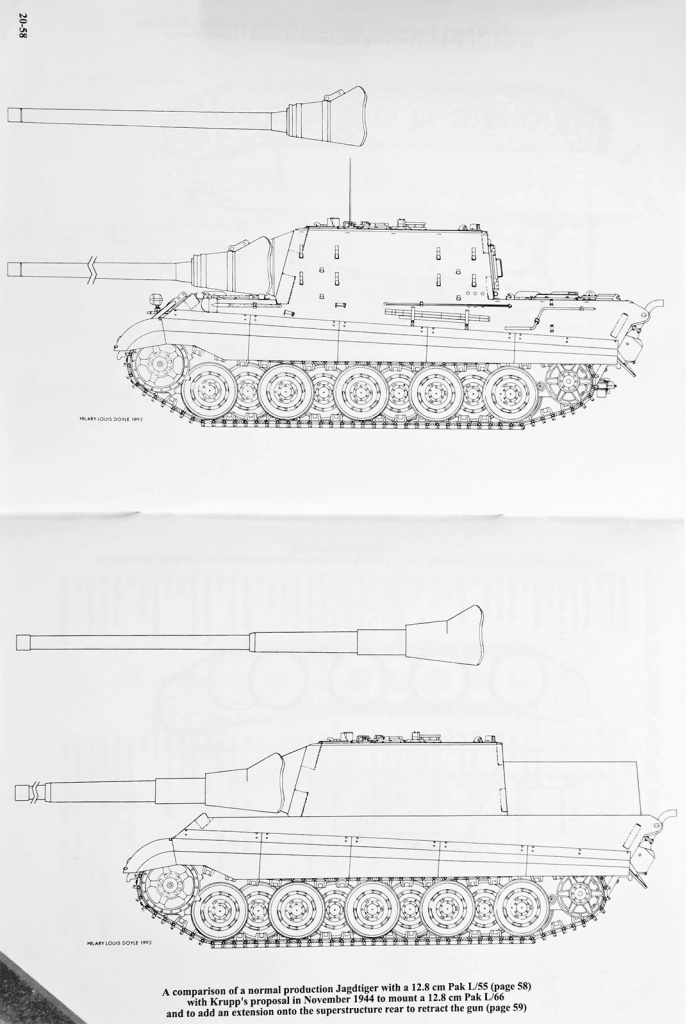
For comparison, the Jagdtiger had a 12.8cm L/55, a gun just above 7m at 704cm.
Below, Krupp's rejected proposal of arming Jagdtiger with a 12.8cm L/66:
At almost 8.5m long, the project was deemed unpractical as it would severely reduce maneuverability and likely gun traverse, changing it from a tank destroyer to armored artillery in Wa Pruef 6's words.
At 7.8m, a 150mm L/52 would be halfway between the two guns in length although likely close to the latter in weight.
Assuming a relatively low recoil cannon (at this stage of the war HEAT would have been the preferred piercing warhead rather than hypervelocity APCR, especially at such high caliber) firing at no more than 600-700 m/s it's likely casemate size requirements wouldn't change from what would have been needed to house the 12.8cm Pak 44 and given that size would be very similar to the Jagdtiger (even the marginally longer Weserhütte plans gave out just enough room to allow rear transmission), meaning anything larger would be highly unpractical.
Assuming minimal engineering and base chassis modification efforts would be allowed (this is the E-series we're talking about, so anything hampering ease of production would be likely avoided), this leaves us two possible possible configurations, one based on the aborted Jagdpanther mit 12.8 Pak 44 and the other being the classical Jagdtiger.
Using Doyle's designs from Panzer Tracts 20-1 we obtain mixed drawings that might look a bit closer to what german engineers had imagined:
The former has the advantage of being closer to the original goals involving rear transmission, although a front casemate design with a long gun would present a large gun overhang, something that was considered undesirable with the long 128mm Jagdtiger proposal, although in this case the rear transmission pack would possibly provide more balance and avoid making the vehicle too nose heavy.
The Jagdtiger-like casemate closer to the center would instead provide better balance as advantage and be closer to historical production reality as it would require relatively less production changes from the design already in the assembly lines.
All in all, given the war ended before even the early suspension tests on a Tiger II hull could be completed this represents mostly an exercise in speculation, although one extremely interesting for the historically minded war-game fan.
A project with such little detail that is often dismissed as modeler kit bash, the stug E-75 is possibly the most elusive E-series project discussed by Ernst Kniepkamp's team.
Although it was a logical extension of the supposedly "standard panzer" E-50/75 chassis, it wasn't until a very careful reading of Spielberger's "Special panzer variants" that I could find a reliable source.
Even there, it just briefly mentioned that the new layout design features gave an increase of 66% in interior space and brought the gross weight to 80 tons.
Further data is given on "Waffen und Geheimwaffen des deutschen heeres 1933-1945" by Fritz Hahn.
Although no design details are available, the planned armament is: 15cm L/52 with an heavy shell weighing around 42 kilos and the weight is pushed up to 85 tons.
This gives a very ambitious project with a hefty engineering challenge.
For comparison, the Jagdtiger had a 12.8cm L/55, a gun just above 7m at 704cm.
Below, Krupp's rejected proposal of arming Jagdtiger with a 12.8cm L/66:
At almost 8.5m long, the project was deemed unpractical as it would severely reduce maneuverability and likely gun traverse, changing it from a tank destroyer to armored artillery in Wa Pruef 6's words.
At 7.8m, a 150mm L/52 would be halfway between the two guns in length although likely close to the latter in weight.
Assuming a relatively low recoil cannon (at this stage of the war HEAT would have been the preferred piercing warhead rather than hypervelocity APCR, especially at such high caliber) firing at no more than 600-700 m/s it's likely casemate size requirements wouldn't change from what would have been needed to house the 12.8cm Pak 44 and given that size would be very similar to the Jagdtiger (even the marginally longer Weserhütte plans gave out just enough room to allow rear transmission), meaning anything larger would be highly unpractical.
Assuming minimal engineering and base chassis modification efforts would be allowed (this is the E-series we're talking about, so anything hampering ease of production would be likely avoided), this leaves us two possible possible configurations, one based on the aborted Jagdpanther mit 12.8 Pak 44 and the other being the classical Jagdtiger.
Using Doyle's designs from Panzer Tracts 20-1 we obtain mixed drawings that might look a bit closer to what german engineers had imagined:
The Jagdtiger-like casemate closer to the center would instead provide better balance as advantage and be closer to historical production reality as it would require relatively less production changes from the design already in the assembly lines.
All in all, given the war ended before even the early suspension tests on a Tiger II hull could be completed this represents mostly an exercise in speculation, although one extremely interesting for the historically minded war-game fan.
Iscriviti a:
Post (Atom)