giovedì 31 ottobre 2013

Early Panzers - German WWI tank development

While we usually delve into obscure prototypes or late WWII tanks, it's worth taking a look into the original panzer development, which is an interesting history of technological catching-up in itself.
When WWI tanks are brought to topic one cannot avoid mentioning the iconic ones, Mark I-IV, Renault FT-17 and the A7V.
Those of course were far from being the only armored beasts that grazed (or better, clawed their way through) the battlefield but the drawing boards were busy with even more projects, as usual going from the pragmatic to the downright unpractical, giving excellent precursors to Hitler's megalomania.

Still, this was the technological cutting edge of the era, with both sides pioneering into armored warfare operations and experimenting original solutions.
While only one german tank design ever saw the battlefields of WWI, designing and prototypes were going strong behind the lines.

A7V

On November 13, 1916 the War Ministry commissioned a tank (the nomenclature Sturmpanzerwagen came only in 1918), disguised under the name of "A7V".

With a planned gross weight of about 30 tons, the design was planned to be able of running cross country, spanning ditches up to 1.5m wide and to reach a top speed of 12km/h.
The armament was planned to include a cannon and several machine guns, while an 80-100HP motor was initially thought to be sufficient (2,5-3,3 HP/ton, could maybe propel the tank to walking pace), while the running gear was based on the popular Holt tractor, which was the base of most early tank designs. 

On December 1916 a draft was published with two 100 HP engines (for a more acceptable 6,5 HP/ton), while constant changes in design happened until spring 1918.
Initially a 2cm decker was proposed but proved ineffectual against armor, so several cannons including the at the time dreaded 7.7cm FK96 field gun, which however proved too heavy for the chassis.

In the end, 57mm the belgian Maxim-Nordfeld QF cannon was chosen due to its low recoil.
This gun might seem puny by WWII standards, however it was able to defeat contemporary armor at fairly long distances, although it's also fair to say that bulletproof would be a more appropriate description of WWI tanks.

Armor was fairly thick by WWI standards, with 15mm all around and critical points reinforced up to 30mm. This was a compromise between the initial design and a request to make the tank more resistant to artillery shells, which would have overloaded the suspensions.
Even this way, the tank was still overloaded and the drive train suffered from high wear and tear, something in common with late WWII designs.


A7V/U and other variants


After the "Cambrai shock" the German army started evaluating to imitate the concept of British rhomboid tanks, as they were seen a superior cross-country design.
This ended up in the A7V/U project, which looked fairly similar to the British Mark IV and was armed with 2 5.7cm cannons in side sponsons.
Larger than the entente tanks, 2 110HP engines were far from enough for propelling the nearly 40 ton chassis and led to a front-heavy tank, while the tracks were easily fouled with sand.
Deteriorating war situation and resource scarcity led to the abandonment of the project in September 1918.

This however wasn't the only planned A7V variant and some more original design were made.
One of those was the A7V-flakpanzer:
Armed with 2 captured Russian 76.2mm cannons, it was parter of a broader effort to motorize anti-aircraft artillery and it might very well be world's first SPAAG.

Other variants included a battle supply carrier, motorized trench-digger and a radio carrier, but ultimately the chassis mobility was seen as insufficient for German stormtrooper tactics (a problem shared with entente captured tanks), so new designs were prepared for Plan 1919.


K-Wagen


Even before completion of the first A7V, an even larger tank was planned.
Called the K-Wagen, it was intended to be an heavy breakthrough tank to be ready for 1919.
The precursor of WWII super-heavy designs, requirements included 4 cannons (or 2 cannons and 2 flame throwers), several machine guns and the ability to cross trenches up to 4 meters wide.

Specs varied during design, and the 13 meters long vehicle started from 100 tons in weight (to be propelled by 2 measly for the task 200HP engines!) and ended up to 150 tons, to be powered by 2 Daimler engines, providing a reasonable 650HP each.

4 77mm fortress guns would have provided considerable firepower, while 30mm all-around armor was a pretty good protection, but all in all, the vehicle was soon considered unpractical and fit only for positional warfare, especially as the tank had to be broken-up for transport and rebuilt for combat.
Still, 2 of those armored monsters were almost finished by the end of the war, almost ready for initial testing.


L.K. I-II-III


The worsening of the war situation led to a radical change in german tank design.
Instead of heavy assault tanks lighter designs were favored, using simpler automotive designs derived from Daimler cars and engines in order to create cheap and simple to manufacture tanks, not unlike the late WWII E-series.

The first Vollmer LK I prototypes were rejected on January 1918 due to insufficient armor protection, as the paltry 8mm were often insufficient to resist even close range rifle fire.
The 8,5 tons LK II fared better, with armor up to 14mm and armed with a quick firing 5,2 or 5,7cm cannon in a rear casemate design.

 Weak suspensions found in testing halted the development, although it was also proposed to rearm the tank with a 3,7cm KWK. This design was to become the basis for the Swedish Stridsvagn M21.
Improving on this, Vollmer proposed a LK III design, with engine and transmission at the rear, using purpose built parts and sporting a front turret, which due to the end of the war remained only on paper.

Oberschlesien 


The poor battlefield performance of A7V led to the design and development of a new generation of assault tanks.
Along with the lighter designs a new heavy tank was proposed under the name of Oberschlesien, or Upper Silesia.
The drawings showed a very modern design for the era, with driver upfront, separate fighting and engine compartments, raised weapons in rotating turrets.

Great care was placed on battlefield mobility, leading to a very light ground pressure of 0.5kg/cc.
The 20 tons tank was powered by a 180HP engine for a top speed of 16 km/h, armed with either a 3,7 or 5,7cm cannon and 2 machine guns, while 14mm of armor gave it decent protection. 
All in all, the central powers found themselves hopelessly trying to catch up and the end of the war led to total stasis for several years. 
Still, had the war went on for longer the central powers showed that they could eventually field designs able to match anything fielded by the Entente.

1919 and 1920 would have shown a much changed battlefield but this would be a topic for a pretty different article...

martedì 22 ottobre 2013

Germany's ultimate motorized cannon: Waffentrager Panther

Being the classical late WWII German swiss-knife tank, the Panther had many planned evolutions.
One of the most interesting and obscure of those was its Waffentrager (gun carrier) configuration.

Early studies were derived from an evolution of the Pz Sfl IV C, with a derived platform using Panther components:

As shown by this specifications, a Panther based Waffentrager armed with a 8.8cm FLAK 41 and most of its armor stripped out would weigh only 31 tons.
From this start Krupp went ahead with draft W1734, using a SFH43 heavy howitzer with -8 gun depression and the estimated weight rose to 34 tons, provided the apparatus for separating the gun from the carrier was not included in the chassis.

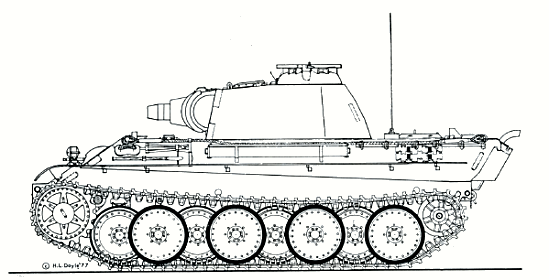
In the end, a wooden model was created, with an open top rotating platform and a gun shield:

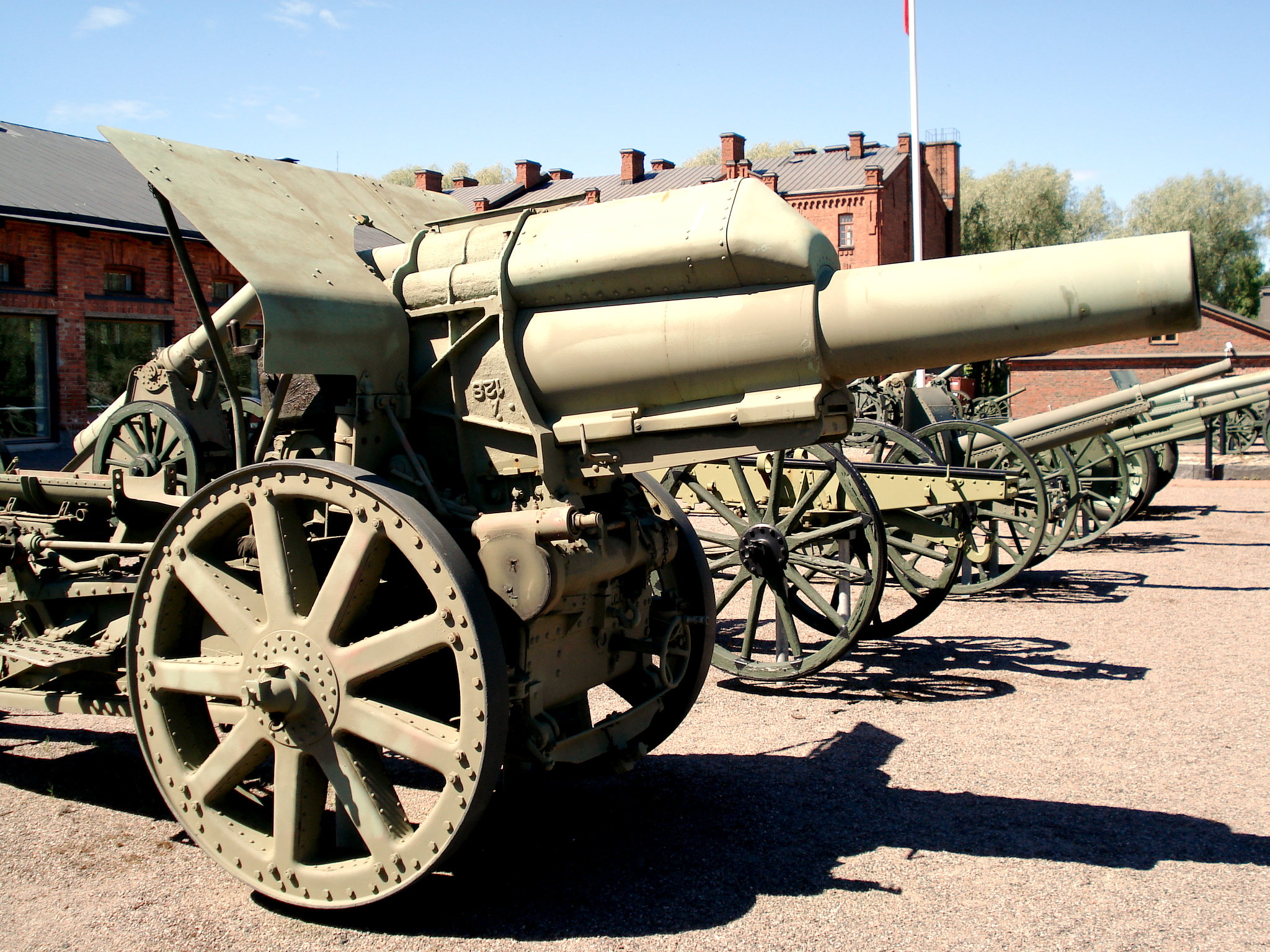
The model shows a 128mm L/55 but the same platform was planned to carry the 15cm SFH 43 plus a 21cm howitzer was planned on 18 march 1944.

The 128mm K43 (analogous to the Pak 44 L/55) woud add approximately 5 tons to the SFH 43 proposal, bringing the weight to 39 tons, still leaving plenty of room for a more powerful cannon as the series tank ended up 45 tons heavy.
There are no details for the 21cm howitzer but two options are likely to have been either the massive 21cm morser 18 (adding almost 7 tons and reaching series Panther weight) or the shorter 18/19 version, which at a modest 9.1 tons it would be almost the same weight as the 128mm L/55, ending with a 39-40 ton tank.

This is of course the historical configuration, but given  the chassis capacity left, a much more extreme design could have been made:

- Panther's 700HP would have given 15-18 HP/ton, good but not enough to really reach the planned 60km/h.
Using the planned HL 234 with up to 900HP we'd easily reach 20 HP/ton, making the tank pretty agile.

- The 128mm L/55 had a 3 rounds drum loader planned, giving the tank good burst capability, but given chassis capability we could extend it further. The longer 128mm L/61 is estimated to be 2-7 tons heavier, still within chassis limits, although balancing the gun would be a challenge.

- Going into the 15cm class, we could consider a few longer 15cm class cannons, up to L/55. This would bring the chassis weight up to 42 tons and still be acceptable in terms of weight but that would be too long to really balance on a turret, so we could instead consider it's smaller L/43 brother which at mere half ton more than the 128mm L/55 delivers a 15cm shell at 757 m/s, enough to give out pretty decent penetration.


All in all, the Waffentrager Panther could have been another real German feline from hell: agile like a leopard, with the bite of a lion but the soft skin of a kitten with 30mm maximum armor.

martedì 17 settembre 2013

Extending the WOT german tech tree - Henschel Heavy Tanks

By Zarax

 Disclaimer: 
This is a purely speculative article that takes into account WOT German tech tree and uses historical tanks to speculate possible new tank additions.
While trying to keep the articles faithful to history some room for inaccuracy is allowed within these rules:

1) No tank or tank part will be 100% made up, at least a mention about tank role and vague specs are needed

2) Components not planned for the tank are allowed, provided it wouldn't create grotesque inaccuracies like putting a gun that would obviously cripple a tank under its weight

3) This will be limited to WWII plans, anything post war risks to be too arbitrary to properly balance

No serious expectation of anything listed to appear in WOT as described is applied, but as we're discussing about implementing history into an arcade game some items will be controversial.
This is unavoidable as WOT tech tree rules need a tank to be better than the previous one and ergonomics are not exactly cared about, meaning that most designs are over-performing their real counterparts.

After the recent general german tank rebalance made by WG which left some players rather disappointed, I think it's a good time to look at historical developments and how they could fit in WOT.
As the Henschel line is slightly better researched this will be more of a rebalance and less of a revolution than the Porsche rebalance proposal, although again the focus will be on bringing better armor for tier, although I'm sure the proposed changes will stir controversy as they touch many community favourites.
The historical sources as usual are Spielberger, Jentz & Doyle with a few lines from Hahn.

Henschel heavy tank development can be traced back to January 1937, when Wa Pruef 6 asked Henschel to develop designs for a 30 ton tank armed with a 7,5cm cannon.
Although not the first development for an heavier design (Großtraktor and Neubaufahrzeug were produced in early 1930s but could be regarded more as parade tanks than battlefield ready designs), Henschel focused on the breakthrough tank role, with focus on all-around armor and guns intended to deal with machine gun nests and small fortifications rather than tank to tank combat, although the experience of France first and Russia later on radically changed this.

Tier III:  Durchbruchswagen


Seen by many players as a rather mediocre tier IV tank, D.W. II would greatly benefit from being brought down a tier.
Facing tier II-V enemies would mean having an armor nearly immune to auto-cannon fire and pretty effective versus most guns of the same tier with angling.
Removing the top 5cm, toning down HP and ROF would make the tank a pretty good defensive machine without becoming overkill.

A tank to be feared in its own tier, it would suffer against tank destroyers and 50mm aren't anything special versus tiers above, let alone if facing tier V tanks.
All in all, it would be a slightly better AMX 38 with similar armor, slightly better guns and similar mobility.

Tier IV:  VK 30.01 (H)

Under-armored and over-gunned at tier V, let alone tier VI where it was placed earlier, VK 30.01 (H) would be a lot more balanced at tier IV.
Sporting the same armor as the previous tier, protection would be rather mediocre for an heavy tank and at roughly the same level as Panzer III, but this would be compensated by fairly good mobility (for an heavy tank) and either the 75mm L/43 or L/48 as top gun. Historically longer guns were considered but the required turret redesign basically meant the tank itself was discarded as becoming inadequate.

Most soft stats could be picked from the current tier IV DW (after all the two tanks were very close relatives) although the improved firepower would mean no preferential match-making.
Strong against the same tier but also only moderately well-protected, it would set the tune for the rest of the line.

 
Tier V:  VK 36.01 (H)


Although pretty balanced as tier VI heavy, the VK 36.01 (H) is yet another over-gunned design as historically it was unable to carry the 88mm cannon.

At tier V it would bring great armor for its tier (on par with the feared KV), still excellent firepower as the current VK 30.01 (H) gun selection plus were its historical guns.
Mobility-wise we could expect similar performance as the KV tank (which isn't too bad for an heavy) to which it would be an excellent counterpart, with less damaging guns but better penetration and better frontal armor but worse sides.

All in all, it would be a good breakthrough tank, able to take some punishment to the front but also punishing for reckless players as mediums of the same tier would easily exploit the weak sides.

Tier VI:  Tiger (H)

Great gun, good mobility but paper armor was pretty much the Tiger's description.
In recent patches this has been brought to the extremes, to the point that the tank resembles very little its historical counterpart except in looks.
Bringing down the tank to tier VI could give armor that lower tiers would find difficult to penetrate with a bit of angling, while HP and soft stats would suffer.

While keeping the current top gun would be somewhat historically accurate, I'm not sure it would be a good idea.
Being able to mount the long 88 means sacrificing a lot in other places, leading to a play style not unlike the french ARL 44, which is not exactly regarded as a great tank, although personally I find it adequate.
As alternative, Rheinmetall's improved 88mm L/56 prototype could also be brought to play, giving +10/15mm penetration over the standard short 88 and allowing decent soft stats so that brawling as top tier wouldn't be a suicidal option.

 After tier VI, two options are available, one following closely battlefield specs, with another being closer to the current WOT.
Let's review them both, starting with the more extreme variant:

Tier VII:  Tiger II 

While Tiger II is currently regarded as well balanced at tier VIII, it doesn't mean it couldn't work one tier down.
Lower front plate is now weaker than it used to be and engine power toned down, so that the tank works best in a partial hull-down position and on flat terrain.
At the same time, what we have in game is Krupp's Tiger II rejected proposal, adding yet again a gun that would barely fit and that would have had an horrid reload time historically.

Using the 88mm L/71 as top gun and reducing mobility (Tiger II never was an agile beast anyway) with a somewhat lower DPM we could have a tier VII with great armor and gun, able to troll lower tiers and stand up to quite a bit of punishment although lacking the agility to be a true brawler.
Tier VIII: E-75
As strange as it may seem, we have no data on planned armor thickness for E-50 and E-75 other than one had stronger armor than the other.
This, connected to the fact the design was never planned to use anything larger than the 10.5cm L/68, would make the tank rather underpowered at tier IX but very possible to be balanced at tier VIII.

The main complaint in WOT would be that the tank is too well protected for tier VIII, and it would be true keeping the current armor. At the same time, that layout is not very realistic for a 75 ton tank.

IMHO armor would have been only marginally better than Tiger II (I'd say 150mm UFP, 120mm LFP, 100mm sides) and most weight would have gone into a larger turret, able to properly house the 10.5cm L/68 and a 2nd loader. A 5 tons margin is not that much considering this factor, even with the promised lighter suspension and optimized layout within the E-series.

Mobility wise we could expect slightly worse than Tiger II (same engines, 5 more tons) in HP/ton ratio, terrain resistance depends on WG as usual.

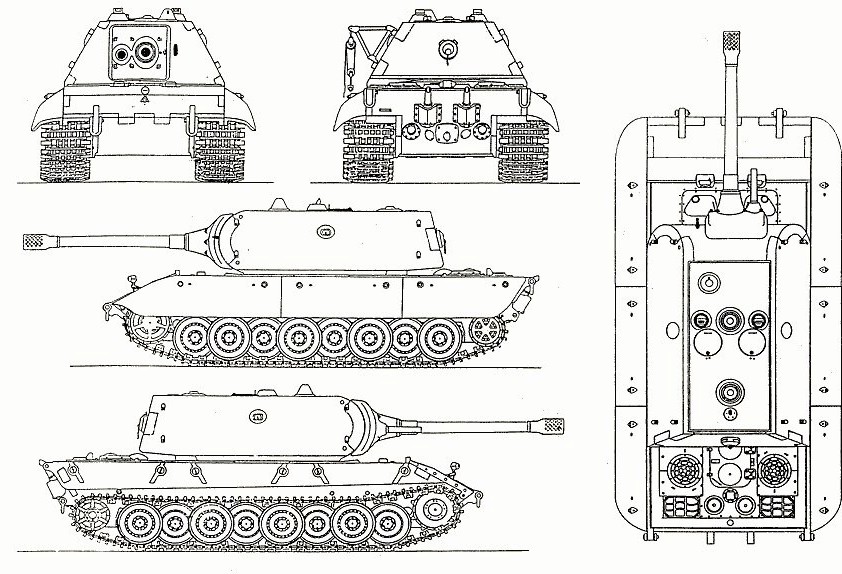
Tier IX: VK 130.01(K)Tiger-Maus


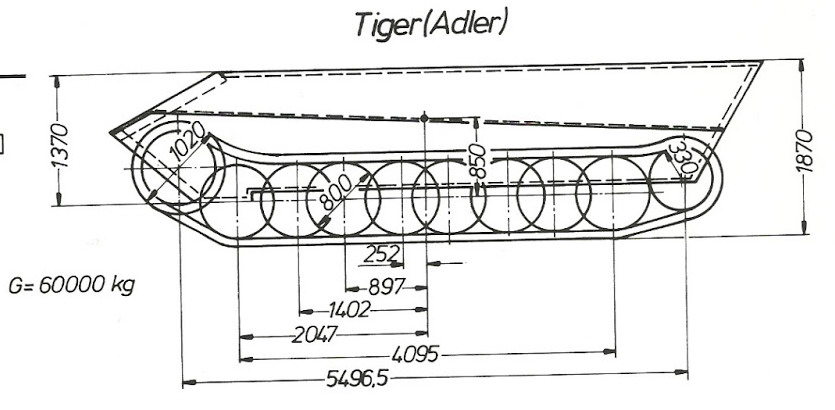
The mighty E-100 was born initially as a Krupp project for a cheaper Maus using production components from the Tiger and Tiger II. 
The first draft called for a prototype using an early Maus turret design and either a MB HL230 design or an optimized version boosted to 1000HP using high octane fuel.

Luckily we also have the turret design available:
Trouble is that it was quite a bit heavier than E-100 turret, pushing the total weight nearly 150 tons.
Even with a 1000HP engine we can expect Maus-like mobility but great armor and good firepower at tier IX.

On the guns side, we could expect the 10,5cm L/68 stock and a choice between Maus 12.8cm L/55 and likely the upcoming 150mm FH L/29,5 from the TD line, although it will likely not have better penetration than the 10,5cm.

This concludes the "radical" variant.
The other option involves leaving alone tier VIII and IX, while introducing a new tank at tier VII.


Tier VII:  VK 45.02/45.03 (H)


 The "demi Tiger II" was initally called Tiger II in itself, while the production Tiger II was the "Tiger III" project.
The initial plans for an improved Tiger called for a sloped armor version of VK 45.01 using essentially the same components and the 88mm L/71, with a frontal armor rated either 100 or 120mm and 80mm sides.

The project in itself was rather short lived as it was ultimately decided to uniform production as much as possible with Panther components, leading to the "Tiger III" project which ended up in the Tiger B we all know.

Performance wise we could expect a tank slightly lighter than a Tiger II using the same engines as Tiger I, so not stellar mobility, balanced by slightly better frontal armor (imagine ARL44 hull with Tiger turret) and the Porsche Tiger II turret as top.

Tier X: E-100

No introduction is really needed, E-100 is unlikely to change much.
Possible buffs are covered in the "Buff my tank! - E-100" article.

I'm sure this article will raise controversy but given the constant WOT rebalancing I wouldn't consider it completely impossible.

Hope you enjoyed reading this article and I will see you in the next one!


lunedì 16 settembre 2013

Extending the WOT German tech tree - Sturmpanzers

 Disclaimer: 
This is a purely speculative article that takes into account WOT German tech tree and uses historical tanks to speculate possible new tank additions.
While trying to keep the articles faithful to history some room for inaccuracy is allowed within these rules:

1) No tank or tank part will be 100% made up, at least a mention about tank role and vague specs are needed

2) Components not planned for the tank are allowed, provided it wouldn't create grotesque inaccuracies like putting a gun that would obviously cripple a tank under its weight

3) This will be limited to WWII plans, anything post war risks to be too arbitrary to properly balance

No serious expectation of anything listed to appear in WOT as described is applied, but as we're discussing about implementing history into an arcade game some items will be controversial.
This is unavoidable as WOT tech tree rules need a tank to be better than the previous one and ergonomics are not exactly cared about, meaning that most designs are over-performing their real counterparts.


With the approaching Waffentrager tree, today we will see my personal take on the possible sturmpanzer tree.
SilentStalker recently had his own take on it, but I disagree on some choices and also prefer a shorter, more intense grind.

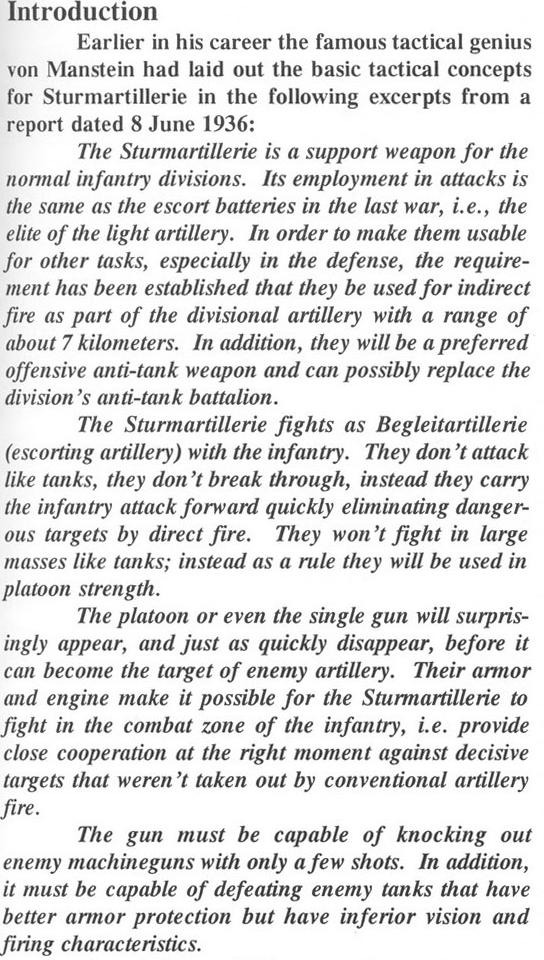
Historically sturmpanzers were basically direct fire artillery platforms, serving as mobile infantry howitzers or as assault guns depending on tank and situation.
Tactically conceived as a blend of artillery and tank destroyer later on specializing in urban fighting, they were very well described by Von Manstein:


The perfect root to start this tree in my opinion is the good old Hetzer. The first derp TD is a perfect platform to introduce the play style that will give character to most of the tanks in the tree, and is going to be followed by a derivative platform:

Tier V:  Selbstfahrlafette s.I.G.33 auf Bergepanzer 38 (t)


A close Hetzer cousin, the tank was born out of the idea of coupling a 15cm S.I.G. to a bergepanzer 38(t) chassis.
Open top and with very thin superstructure armor ( sources vary between 20-30mm front and 12-20mm side), but likely sharing excellent camo with Hetzer coupled with  a good view range, this tank was planned to be around 16.5 tons and powered by a 150HP engine, for a decent 13HP/ton ratio, it's likely it would share the same engines with its lower tier cousin, making the tank pretty agile as well.

All this awesomeness is in turn balanced by pretty poor ergonomics, as gun traverse was limited to 7° per side and gun depression to 2°. Ammo capacity was also limited to 15 rounds, meaning every shot must count.

All in all, we can expect a stock experience with the Hetzer 105mm howitzer and a similar stock engine, ending with the mighty 15 SIG, giving similar but likely even less accurate firepower due to a much shorter barrel.

Tier VI: Sturm-Infanteriegeschütz 33B


The fierce battles around Stalingrad created the necessity to have an heavily armored assault gun.
In the urban context high muzzle velocity and long range accuracy were of little value, but armor was of the utmost importance. The resulting tank was a box-like superstructure on a Panzer III chassis.

Unlike its predecessor, the StuIG 33b was pretty well armored, with 80mm front, 50mm side and 15mm in the rear, which brought a total weight of 21 tons.
Ergonomics are again pretty restricted, with a traverse of a mere 3° per side as well as a gun depression of 3°.
Maximum speed is listed at 20kmh, although given weight and engine power it seems unlikely, so my personal suspect is that either the listed weight is wrong (likely and by at least 5 tons), or the speed is at least 10kmh higher than listed.

On the firepower side, we can expect stock the SIG 33, an intermediate upgrade to the SIG 33 model 1939 (slightly better aim time) and end it with the 15cm STUH 43, with improved accuracy.
Engine-wise we can expect the same selection as the STUG III, so no surprises there.

A decent armor upgrade overall, with some loss of agility.


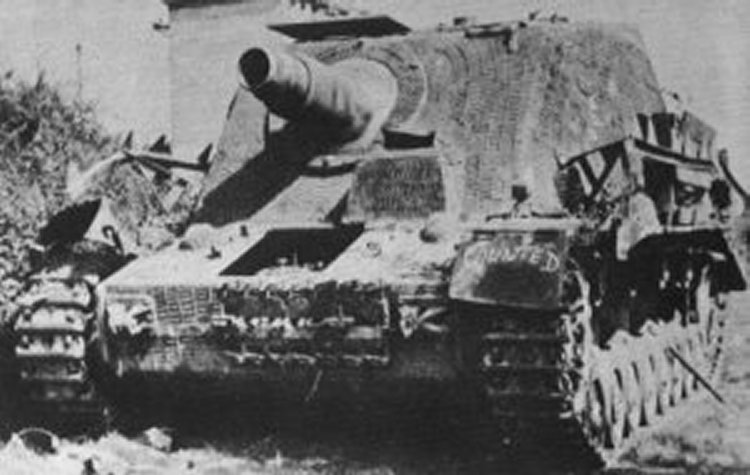
Tier VII: Sturmpanzer IV Brumbarr


As the Panzer III chassis proved to be inadequate for the fierce fighting around Stalingrad, the Sturmpanzer IV was originally born as a replacement for the Ferdinand Sturmpanzer variant (another awesome design, which planned to use a captured 22cm french howitzer).
A vast improvement over the StuIG 33b, the Stupa (as it was nicknamed by troops) was very appreciated especially by infantry, which often called upon them and also fought in a TD role at Kursk in support of the Ferdinands.

A decent 100mm sloped at 38° gives slightly better frontal protection than the mighty Tiger, while sides were 50mm at  15° and rear 20 at 10° so getting flanked is a pretty bad idea.
Top speed is listed at 40kmh, although 265HP for 28 tons gives a mere 9HP/ton, although we can safely estimate Panzer IV top engine will bring the ratio to a decent 15 HP/ton.

On the firepower side, stock we can safely expect the 15cm STUH 43 while upgrades here gets a bit tricky, as historically a very short 21cm howitzer was planned but would be impossible to balance at tier VII, so instead we could play with the 15cm SFH 13 L/13 (a short variant of the Grille top gun), which would improve accuracy.
Ergonomics are vastly improved though, so we can expect 7° traverse on each side and a decent 5° depression.


Nothing revolutionary from the previous tier, it's still a decent answer to SU-152 and sports decent armor versus lower tiers.

Tier VIII: Sturmpanther


Following Stalingrad, a new Sturmpanzer design was requested, this time on a Panther chassis.
Krupp quickly created a draft of a 15cm STUH 43 in a Panther turret, using Tiger's commander cupola and Maus' gun sight.

Panther's chassis and turret were otherwise left untouched, so we can expect a fairly agile TD, with a turret nonetheless. 
Upgrade-wise the same shortened 21cm howitzer as for the Brumbarr was planned, but of course it's unlikely it would fit in a turret.

Here we have two possibilities: either we abandon the turreted chassis and we use the Jagdpanther-based proposal of which no drawings are available or we find a turret able to fit a bigger gun, not a schmaulturm for sure.

Luckily for us, a larger turret is available from the Waffentrager designs:


In this picture you can see the tank with the 15cm SFH L/29.5 howitzer which will be featured in the Waffentrager line (why wasn't this design picked instead of overburdening the Panzer IV waffentrager or the fantasy WT E-100 is a mistery to me), something big enough to hold a long-ish 15cm or the mentioned short 21cm howitzer.

As there is no actual design mentioned, one could think it was basically a sawn off version of this baby, the 21cm Morser 16 (which would have been retired from main line use so in surplus):


Such awesome firepower would be balanced by horrid soft stats, however in skilled hands this TD would be a truly deadly tank, although still an appetizer in firepower compared to what will follow.

Tier IX: Sturmpanzer Bar


Awesome firepower comes with awesomely horrid sacrifices in every other area.
The Sturmpanzer Bar comes from a March 1943 requirement for a Sturmgeschutz able to mount a 305mm L/16 howitzer, two months later a conceptual design simply called Bar (Bear) was completed.
Planning to use a mix of Panther and Tiger components, this behemoth of steel would have weighted 120 tons, 8.2m long, 4.1m wide and 3.5m high.
Historically, the tank project was discarded on the same day as its completion, as Alkett/Henschel's Sturmtiger plan proved to be much more effective and economical just at first glance.

Poorly armored at 100-130mm sloped front and 80mm side, the planned Maybach HL 230 engine would have given in an anemic 5.8 HP/ton, for a maximum speed of 20kmh.
Ergonomics were also rather poor, with 0 gun depression and a traverse of mere 2° on each side.

All of this would be compensated by the gun. A 305mm HE shell is more than enough to ruin even a super-heavy tank day, supplemented by an HEAT beton-grenate which would penetrate at least 300mm armor, for nearly guaranteed one-shot capability regardless of the target.

Still, this tank would represent a true test of willpower, a tank requiring the patience of an artillerist, greatly depending on proper positioning and good team-work.
After all, how good could be something discarded so quickly?


Tier X: Sturmtiger


This classic steel beast needs very little introduction.
Coming from the very same requirement that resulted in the Bar draft, Speer himself contracted Alkett to develop a project to mount a 38cm marine rocket launcher on a Tiger chassis, after the earlier proposal of mounting a 21cm Morser 18 proved too heavy for the chassis.
Alkett initially proposed a rear casemate/frontal engine design which was quickly rejected, followed by a design of a frontal casemate with the 38cm launcher in a ball mount.

Frontal armor was 150mm at 47° with 80mm sides, lower front plate was 100mm often reinforced by an additional 50mm plate, not exactly stellar as top tier.
The MB HL 230 P45 engine gave it 700HP for 68 tons, which gave a power to weight ratio of  around 10 HP/ton, for a top speed of 40kmh.

Ergonomics are decent but nothing stellar: 0/ +70 gun depression and a traverse of 10 degrees on each side.
380mm with both HE and HEAT shells gives it the most devastating punch one could imagine, accuracy will be pretty abysmal though, worse than most howitzers (10m dispersal at 1000m, so in game something close to 0.8-1.0).

In conclusion...

Awesome firepower requires extreme patience and skill to be properly used, imho the mid tiers will be the places where most fun is to be had.
Still, any of these babies in Himmelsdorf will be a sight to be feared!

domenica 25 agosto 2013

Musée Royal de l'Armée - Bruxelles

Just back from that wonderful city, I had the chance to visit the Belgian Army Museum of Military History.
Although some expositions were under renovation (unfortunately both the WWI section and most of their tanks), it was still a pretty interesting tour and I couldn't resist taking some pictures and sharing with you guys.

Unfortunately a strict no flash policy and phone camera means picture quality isn't as good as I'd like, but nonetheless...

Enjoy: